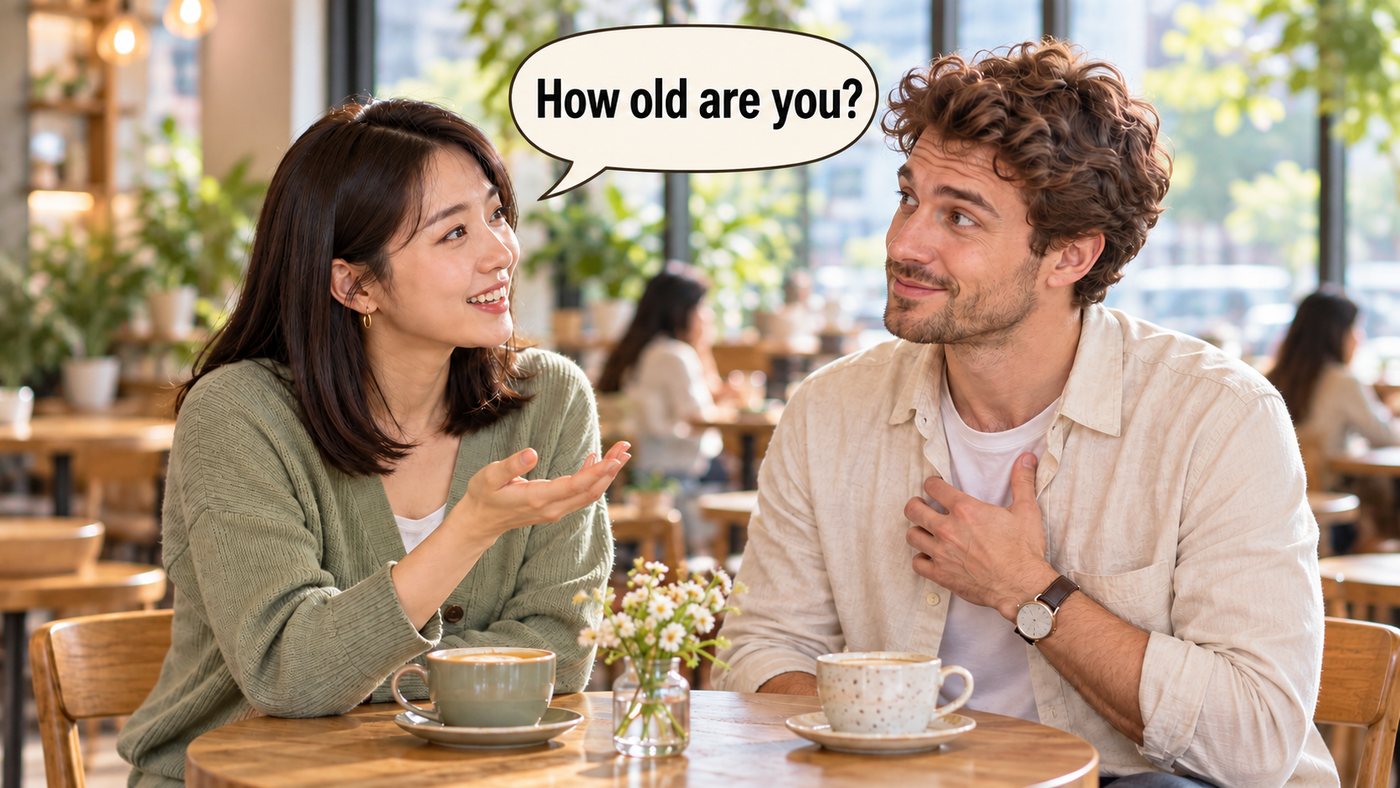
People ask your age the moment you meet, bump into you without a word, and don't chat with strangers, yet once you get close they can suddenly turn warm. Most of the behavior that seems strange has a reason behind it.
As of October 2026 — it can differ by person, generation and region.
After just a few days in Korea, foreign friends start swapping the same questions. "Why do they ask my age before my name?" "Why do people just keep walking after bumping into me?" This article picks 12 of those questions and explains why it happens and what makes it easier to handle. It differs from person to person and generation to generation, so please read the explanations below as "this is often the case."
| Situation | Common reason | Try this |
|---|---|---|
| They ask your age first | To decide on speech style and how to address you | Answer with "I was born in (year)" |
| They also ask about your job and marriage | To find common ground quickly | Answer only as much as you're comfortable with |
| They stare at you | It still feels novel (especially to older people) | Smile and let it go |
| No word after bumping into you | In crowded places people tend to take it as normal | Apologize if you bump into someone in a quiet place |
| They push on the subway | Rush-hour crowds, and people are in a hurry to get off | When getting off, say "naerigetseumnida" (I'm getting off) in a loud voice |
| They don't talk to strangers | Nunchi, consideration, and a changed society | Try not to feel hurt |
| Suddenly warm once you're close | Jeong (情) builds up slowly | Accept small kindnesses |
| Hard to make friends | Friendships form inside existing groups, and experience with foreign friends is still limited | Classes, clubs, sports groups |
| Banmal vs. jondaetmal is confusing | It's set by age and relationship | Default to haeyo-che (the polite "-haeyo" style) |
| They answer in English when you speak Korean | They want to help | Keep speaking Korean |
In Korean, the way you speak and the way you address someone change depending on the other person's age. So you need to know their age to decide "whether to use formal speech (jondaetmal), whether to speak casually, and what to call them." In most cases people ask to decide how to speak, not to be rude.
By the way, since June 28, 2023, legal and administrative age has been unified as international age (man-nai). Even so, in everyday life people often ask "myeot nyeonsaeng-iseyo?" (what year were you born?) and ask for your birth year.
Answering with your birth year instead of your age sounds natural. If you'd rather not say, smiling and saying "it's a secret" is usually not a big problem.
With people they've just met, Koreans tend to look for common ground quickly to keep the conversation going, so they may end up asking foreigners questions that feel close to private life. The intention isn't to judge you but to get closer to you.
Older people in particular often see foreigners with feelings similar to those they have for their own children. They ask all sorts of things and try to look after you as they would family, so the questions can feel deeper to a foreigner.
It's fine to answer an uncomfortable question briefly and change the subject. For a question like "Where are you from?", answer easily and ask them back, and the conversation flows on naturally.
As its economy grew rapidly, Korea went within a single generation from a time when there were hardly any foreigners to today, when you run into a great many of them. So many people still find it novel that there are so many foreigners. Even people in their 40s as of 2026 rarely saw a foreigner in Busan when they were young.
It may feel even more remarkable to older people. They lived through very hard times after the Korean War, so when they see that Korea is now a country where foreigners come to work and study, they feel amazement and sometimes compare it with those days. That's why, even in big cities like Seoul, some people say "oegugin-ida" (it's a foreigner) as if talking to themselves.
Most of these reactions are explained as harmless, but not every stare is curiosity. If unpleasant things keep happening, don't put up with it alone. Tell the people around you or a counseling desk at your school or workplace.
A light nod of acknowledgment, or simply pretending not to notice, is usually where it ends.
It depends on the situation. Korea has a very high population density for its land area, and a lot of those people live packed into big cities. So in places where people crowd together, such as public transport, bumping into others happens all the time. Apologizing every single time is practically impossible in daily life, so people have built up the experience of letting it go in crowded places with a "that's bound to happen." As a result, even a fairly hard bump is often brushed off as something that can happen.
On the other hand, if someone bumps into you somewhere you wouldn't expect to bump into anyone, they are relatively much more likely to apologize. The difference between the two situations is quite large.
That's why Koreans, too, sometimes miss the moment to apologize. They don't apologize when it's crowded, and then in a situation where they should, if they're just passing by, they get briefly confused about "should I apologize now?" Then they pass without saying anything and think to themselves, "Oh, I didn't apologize." It may be a case where they couldn't apologize, rather than one where they didn't.
In crowded places it's not strange for people to pass each other without a word. If you bump into someone in a quiet place, it's natural to say "joesonghamnida" (I'm sorry) first. You don't need to feel hurt if the other person doesn't apologize.
It's for the same reason as No. 4. In places that are too crowded, many people push, and this is something Koreans themselves complain about a lot. Pushing on the subway in particular is quite common.
At rush hour, Korean subways run on schedule. If you don't move quickly at the door, you may not be able to get off, so in their hurry people end up pushing a lot.
One more thing: although the rule is to let people off first and then board, older people tend to try to board before people have gotten off. They want to get a seat, and since standing is hard for older people, most people understand and let it go.
When getting off, saying "naerigetseumnida" (I'm getting off) in a slightly loud voice rather than a soft tone makes people step aside more readily. When standing, avoiding the spot right in front of the door makes things much easier.
If you say hello in a cafe or an elevator, they may say "Ne?" (Huh?) back or seem awkward. It isn't that Koreans are cold. There are roughly two reasons.
One is how neighbor relations have changed in apartment buildings and other shared housing. Before apartments existed, people in a neighborhood visited each other often and knew each other well, and even when apartments first appeared, neighbors greeted each other readily. Especially in corridor-type apartments, where several households share one hallway, people ran into each other often and naturally said hello. These days people move often and more people work, so there are fewer chances to see neighbors' faces. That's why people greet each other less even when they meet in the elevator.
The other is that, across society as a whole, relationships form quickly and disappear quickly. Korea, especially its big cities, has so many people that you pass countless people in a single day. Greeting every one of them is practically impossible. So people have become used to not greeting people in most situations. When someone used to that daily life meets a foreigner and gets a friendly nod, they don't know how to react and feel awkward.
So it's closer to an awkwardness that comes from having little daily habit of greeting strangers than to coldness.
Jeong (情) is an important part of Korean culture with a historical background. At first there's a period of reading the room (nunchi) to see whether this is a person you'll stay connected with. After that period, people give their hearts very generously. Jeong doesn't build up all at once, so the warmth arrives slowly.
Once jeong forms, people give their hearts so freely that they'll want to share even the side dishes their mother made. This ties into the historical environment. In traditions like pumasi (neighbors helping one another with farm work) and in a history of having to fend off foreign invasions together (explained in No. 8), a feeling of looking after one another and relying on each other grew deep. That's why, once people start giving their hearts, they give a lot.
Don't turn down small kindnesses. Accept them gratefully. If you later return the favor, even with a cup of coffee, the relationship gets close much faster.
In Korea, friendships are often made inside groups that already exist, such as school, a department, a dongari (club) or a company. So it's hard to become friends right away with someone you happen to meet. On the other hand, once you belong to the same group, you get close quickly. There are two more reasons that come from Korean society's background.
One is a history with a strong power of banding together. Koreans emotionally share a sense of being "hanminjok" (one people). It is often explained this way: on land that was poor for farming, they had to feed a large population, so they could not do without cooperating, and through countless foreign invasions they had a survival history of having to fend them off together regardless of social status.
So banding together happens often. In the late 1990s during the IMF crisis, people even donated gold to pay off the foreign-currency debt early; at the 2002 World Cup they cheered as one; and at the Taean oil spill they cleared the oil and restored nature so quickly that it is rare even by global standards. That is the kind of background that makes it easy for them to get close among themselves.
The other may be the same reason as in No. 3. Foreigners were rare in the past, and within just a few decades people started seeing a great many of them. Foreigners have become more visible, but not many people have had the experience of having a foreign friend right next to them, so experience in getting close to foreigners from different cultural backgrounds hasn't yet built up enough. This may take some time.
So if you'd like to make Korean friends, these approaches are comfortable.
The safest default is haeyo-che (the polite "-haeyo" style: "~해요", "~이에요"). With people you've just met, staff and older people, you'll almost never go wrong using it.
Often it's because they assume Korean must be hard for you and want to help, or because they want to practice English. They aren't brushing you off.
If you keep speaking Korean, most people will switch to Korean. When you're in a hurry, it's also fine to go along with the English they answer in.
| Situation | Good to know |
|---|---|
| Giving and receiving things | Giving and receiving with both hands is a sign of respect toward older people. If you're unsure, both hands are the safe choice. |
| Shoes | You take them off in homes, temples, restaurants where you sit on the floor, and guesthouses. A floor raised by one step and a shoe rack are the signals. |
| Tipping | You don't tip at restaurants or in taxis. The idea of a "service charge" isn't common in Korea. It's a society where kindness is the baseline, as the saying "the customer is king" suggests, so kindness isn't priced separately. |
| Paying the bill | Tendencies differ by age. Among people in their 30s and younger, dutch pay (everyone pays for themselves) is well established, while people in their 40s and older have a stronger tendency for one person to pay. If someone treated you, it's natural to pay them back next time with a cup of coffee. |
When you receive a drink from an older person, it's good etiquette to receive it with both hands and drink with your head turned slightly aside. It's a way of showing respect to elders, and it is still observed today. However, the culture of pressuring people who don't drink to drink has nearly disappeared.
| Remember | In one line |
|---|---|
| Age questions | They ask to decide how to address you and how to speak |
| Silence | It isn't coldness, it's a way of keeping distance |
| Jeong (情) | The warmth comes late, but it lasts |
| Speech style | Default to haeyo-che; for staff, "yeogiyo / jeogiyo / sajangnim" |
| Etiquette | No tipping, and both hands for elders |
This article is a general cultural guide. People may act differently depending on the person, generation and region.