Busan Trash Rules: When and How to Throw Things Away — 11 Waste Sorting Questions Foreigners Ask Most
Trash has to go out on set days and at set times, in the right bag. Here are 11 questions about waste sorting that foreigners in Busan ask most often.
As of October 2026 — days and times differ by district. Be sure to check the guidance for where you live.
Check this first
Apartment complexes and officetels (오피스텔) often have their own disposal areas or processing facilities inside the complex, and many complexes run on their own rules. So you may not have to follow the district office's complicated day and time rules. When you move in, ask the management office (관리사무소) first. They will explain how the complex handles general waste, food waste, recyclables, and even bulky waste (대형폐기물).
This guide is the district-office guidance for people who live in villas (빌라), multi-household houses, and detached houses, which have no disposal area or rules of their own.
At a glance
In Korea, you can't throw trash away at any time or in any bag. This guide picks 11 questions that foreigners living in Busan ask often and sums up what you need to follow. Days and times differ by district, so it is based on district-office guidance for Busan's 15 districts and Gijang-gun (기장군, a county): Dong-gu (동구), Seo-gu (서구), Nam-gu (남구), Buk-gu (북구), Dongnae-gu (동래구), Suyeong-gu (수영구), Yeonje-gu (연제구), Busanjin-gu (부산진구), Geumjeong-gu (금정구), Yeongdo-gu (영도구), Gangseo-gu (강서구), Saha-gu (사하구), Sasang-gu (사상구), Jung-gu (중구), Haeundae-gu (해운대구), and Gijang-gun (기장군).
Question
Key point
Where to check
When to throw it out
Only on set days and at set times
District office (구청) or community center (행정복지센터 / 주민센터)
Which bag
Use the designated volume-based waste bag (종량제봉투)
Convenience stores and supermarkets
Food waste
Put it in a dedicated food-waste bin (전용 용기), separate from general waste
District office (구청) or management office (관리사무소)
Recyclables
Sort by item and put them out on the set day
District office (구청) guidance
Big items
Report them first, then put them out
Bulky waste (대형폐기물) report to the district office (구청)
If you don't follow the rules
Your trash may be left uncollected, or you may get a fine (과태료)
District office (구청) guidance
1. Can I throw trash away at any time?
No. In Korea you can put trash out only on set days and at set times. You must not leave it in front of your home or building outside those times. This is what surprises newly arrived foreigners the most. Some people thought they could throw trash away whenever they liked and later said it was "a big misunderstanding."
In Busan, general waste and food waste are usually put out on Sundays, Tuesdays, and Thursdays in front of your front gate, or at the ground-floor entrance of a shop. Almost every district uses the same days and places, and you can't put trash out on Fridays and Saturdays. What differs is the time. The table lists the times for 16 areas, based on district and county office guidance.
District
Put-out time
Dong-gu (동구)
18:00–22:00
Seo-gu (서구)
After sunset–22:00
Nam-gu (남구)
18:00–23:00
Buk-gu (북구)
19:00–23:00
Dongnae-gu (동래구)
19:00–22:00
Suyeong-gu (수영구)
18:00–23:00
Yeonje-gu (연제구)
20:00–23:00
Yeongdo-gu (영도구)
20:00–22:00
Jung-gu (중구)
19:00–22:00
Gijang-gun (기장군)
20:00–midnight
Sasang-gu (사상구)
20:00–23:00
Saha-gu (사하구)
19:00–22:00
Gangseo-gu (강서구)
17:00–19:00
Geumjeong-gu (금정구)
19:00–22:00
Busanjin-gu (부산진구)
19:00–21:00
Haeundae-gu (해운대구)
18:00–21:00
In Busanjin-gu (부산진구), the days differ by neighborhood (zone) even within the same district. Food waste goes out on Sundays, Tuesdays, and Thursdays everywhere, but for combustible general waste, areas such as Bujeon, Buam, Dangam, Choeup, and Yeonji use Tuesdays and Thursdays, while Yangjeong, Jeonpo, Gaya, Beomcheon, and Gaegeum 1- and 2-dong use Mondays and Wednesdays. See the Busanjin-gu (부산진구) table in question 5 (recycling) for the neighborhood details.
Gijang-gun (기장군) works in two ways depending on the area. Most villages, such as Gijang-eup, Jangan-eup, Ilgwang-eup, Jeonggwan-eup, and Cheolma-myeon, put trash out in front of the house in the evening, as in the table above. Some other areas use village-by-village collection where a collector rings a bell as they go around (타종수거), from 07:00 to 12:00, and the days are different too. Apartments are not covered by this bell collection.
2. Can I use any trash bag?
No. General waste has to go in the designated volume-based standard bag (종량제봉투). If you put it out in an ordinary plastic bag, it may not be collected. The Dong-gu (동구) guidance also says that putting trash out without a standard bag can lead to refused collection and a fine (과태료).
You can buy volume-based waste bags (종량제봉투) at convenience stores and supermarkets, and the price depends on the size. Prices may differ by district, so it's a good idea to start with a small size.
Type
Suyeong-gu (수영구)
Yeonje-gu (연제구)
Volume-based waste bag (종량제봉투) 3L
140 won
130 won
Volume-based waste bag (종량제봉투) 5L
220 won
200 won
Volume-based waste bag (종량제봉투) 10L
430 won
390 won
Volume-based waste bag (종량제봉투) 20L
850 won
770 won
Volume-based waste bag (종량제봉투) 30L
1,280 won
1,150 won
Volume-based waste bag (종량제봉투) 50L
2,070 won
1,860 won
Volume-based waste bag (종량제봉투) 75L
3,080 won
2,770 won
Food-waste payment tag (납부필증) 3L
240 won
240 won
Food-waste payment tag (납부필증) 5L
400 won
400 won
Food-waste payment tag (납부필증) 20L
2,000 won
2,000 won
The prices above are based on guidance from the Suyeong-gu (수영구) and Yeonje-gu (연제구) offices. Bag prices differ by district. For example, Gangseo-gu (강서구) lists ordinary volume-based waste bags (종량제봉투) at 150 won for 5L, 510 won for 20L, and 1,830 won for 75L.
Try this
Avoid putting trash out in a plastic bag you already have at home. It has to go inside a standard bag.
3. How do I throw away food waste?
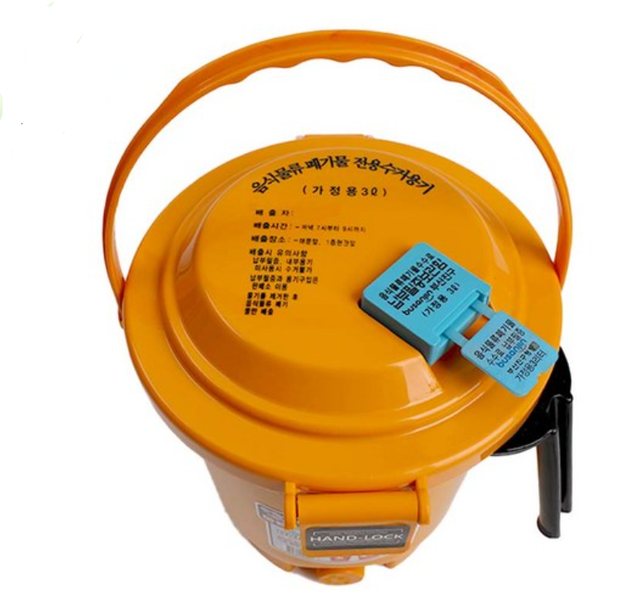
Food waste is thrown away separately from general waste. In detached houses and villas (빌라), you put it out in a dedicated bin (전용 용기), not a bag, and each time you must attach a payment tag (납부필증), a plastic "chip," to the bin. Without a chip, it won't be collected. You pay a fee based on how much food waste you throw away, which is the same idea as buying food-waste volume-based bags in some Seoul districts. The difference is that you use a bin instead of a bag, and you pay the fee with a chip.
When do I put it out? Food waste also goes out on the same Sundays, Tuesdays, and Thursdays as general waste, in front of your gate or at the ground-floor entrance, during the evening hours set by your district. You can't put it out on Fridays and Saturdays. See the table in question 1 above for each district's hours.
When you move in, ask the real estate agent (부동산) or your landlord first. They can tell you fastest whether the home already has a dedicated bin and where to buy one. The steps to get ready are as follows.
Buy a dedicated bin (전용 용기). They are sold at stores designated by the district office, such as neighborhood supermarkets. For homes, there are 3L and 5L sizes. They are also sold on online shopping sites like Coupang, but check that the bin is the right one for your district before you buy. You buy a bin once and keep using it.
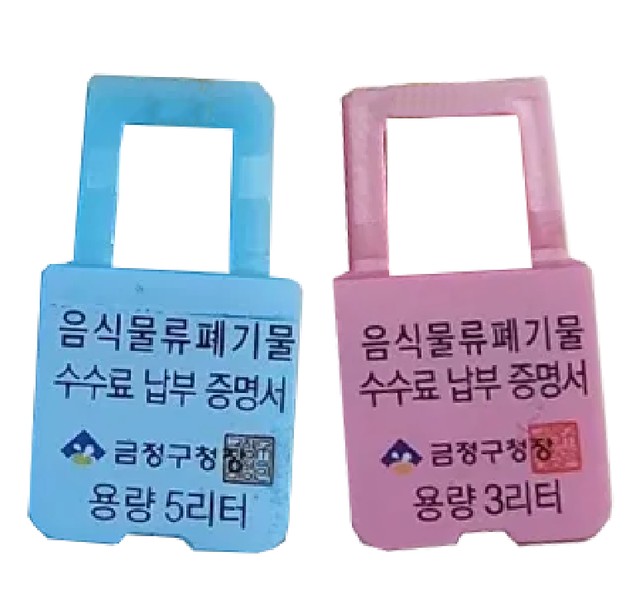
Buy payment tags (납부필증, "chips"). The chip is the fee you pay each time you throw away food waste. Buy several at once from a district-designated seller, such as a volume-based waste bag (종량제봉투) store or a Saemaeul Geumgo (새마을금고) branch, and use one each time.
Fill the bin and attach a chip. Put one chip that matches the bin size into the tag holder (꽂이) near the lid of the bin.
Put it out in front of your gate. The collector removes the chip and empties the food waste. Bring the empty bin back inside and store it.
Here is what the dedicated bin and the chips look like. The lid shows the put-out time and place, and you insert the chip into the holder next to the lid. Chips come in a different color for each bin size, and colors and shapes may differ by district.
Dedicated food-waste bin (전용 용기), 3L for homesPayment tag (납부필증) chips (left: 5L, right: 3L)
Here are the prices (based on Haeundae-gu (해운대구) and Nam-gu (남구) guidance, unit: won).
Type
3L
5L
20L
Dedicated bin (전용 용기)
8,500
9,000
18,000
1 chip (납부필증)
240
400
2,000
The 20L size is for businesses. Bin prices vary by seller and district; Saha-gu (사하구), for example, lists 3L at 6,500 won and 5L at 7,000 won. Many apartment complexes and other multi-unit housing (공동주택) use shared collection bins inside the complex, and the management office (관리사무소) will tell you how it works.
Try this in summer
In hot weather, food waste spoils quickly and fruit flies appear. First, drain as much water as you can. Leave it in a strainer, or wrap it in paper towels or newspaper and squeeze it well, and the smell and weight go down. Then put small amounts in sealed containers or bags and freeze them until put-out day, which keeps down smells and bugs. When you put it in the freezer, seal it tightly so it doesn't touch other food, and keep it together in one separate section. A TV investigation also found that bacteria grew in freezers where food waste was frozen, so don't keep it long. Empty it out in time for put-out day.
4. Are chicken bones and onion skins food waste too?
This is what foreigners get confused about most. Not everything you eat counts as food waste. The rule is that things that can be used as animal feed are food waste, and things that can't (bones, hard shells, dregs, and so on) are general waste (according to Yeonje-gu (연제구) guidance). It may differ slightly by district.
Item
Where it goes
Chicken and pork bones
General waste. In Nam-gu (남구) it goes in the volume-based waste bag (종량제봉투). Suyeong-gu (수영구) says large bones such as soup bones go in non-combustible waste (불연성)
Onion skins, garlic stems, green onion roots
General waste
Corn cobs
General waste
Hard pits such as peach, apricot, and persimmon
General waste
Hard shells such as walnut, chestnut, and peanut
General waste
Shells such as clam, turban shell, and abalone
General waste or non-combustible (불연성), depending on the district. In Nam-gu (남구), it goes in the general waste volume-based waste bag (종량제봉투)
Tea bags, tea and coffee grounds
General waste
Leftover rice, vegetables, fruit peels
Food waste
Try this
If you're not sure, ask the district office (구청) or the management office (관리사무소). Many Koreans get confused and ask too.
5. How do I sort recyclables?
Recyclables (재활용품) are put out sorted by item on set days. Most districts split them between Mondays and Wednesdays. The table below uses Dong-gu (동구) guidance as an example.
Day
What goes out (Dong-gu (동구) example)
Sunday
Food waste, combustible general waste
Monday
Clear PET bottles, cans, scrap metal, plastic, used batteries, used fluorescent lamps
Tuesday
Food waste, combustible general waste, non-combustible general waste (20L non-combustible waste sack, 불연성 전용마대)
Wednesday
Paper, cardboard, glass bottles, Styrofoam, clothing, single-use plastic bags, small used appliances
Thursday
Food waste, combustible general waste
Friday and Saturday
Not allowed
Before you put items out, empty the contents and rinse them once, and remove parts made of other materials, such as bottle caps and labels. See the table below for how to handle each item.
Here are the recycling days by district. They differ a little from district to district.
Nam-gu (남구) Monday: paper, paper packaging, vinyl, plastic, yogurt bottles (clear PET bottles separately) Wednesday: cans, scrap metal, glass bottles, clothing, Styrofoam, small used appliances, non-combustible waste (in the dedicated sack, 불연성 마대)
Yeonje-gu (연제구) Monday: colored PET bottles, film, vinyl Tuesday: yogurt bottles, Styrofoam Wednesday: clear PET bottles, paper, cans, scrap metal, old clothes, used batteries, etc.
Jung-gu (중구) Monday: cans, bottles, scrap metal, plastic, milk cartons, small used appliances Wednesday: paper, clothing, vinyl packaging, Styrofoam, small used appliances
Gijang-gun (기장군) Monday: cans, scrap metal, glass bottles, clothing, plastic bags, film packaging Wednesday: paper, PET bottles, yogurt bottles, plastics, rubber, Styrofoam, used fluorescent lamps, small appliances
Sasang-gu (사상구) Monday: bottles, vinyl, paper, Styrofoam, clothing, used fluorescent lamps, used batteries, power banks Wednesday: plastic, cans, scrap metal, clear PET bottles, yogurt bottles, small used appliances
Saha-gu (사하구) Monday: plastics (including colored PET bottles), vinyl, yogurt bottles, clothing Wednesday: clear PET bottles, cardboard, paper, paper cartons, glass bottles, Styrofoam, cans, scrap metal, used fluorescent lamps, used batteries, etc.
Gangseo-gu (강서구) Monday: colored PET bottles, ordinary plastic Wednesday: clear PET bottles, small used appliances
Yeongdo-gu (영도구) Monday: paper, vinyl, cans, bottles, clothing, Styrofoam Wednesday: small appliances, plastic, clear PET bottles, milk cartons
Geumjeong-gu (금정구) Monday: paper, clothing, vinyl, Styrofoam, small used appliances Wednesday: plastics, glass bottles, cans, scrap metal
Haeundae-gu (해운대구) Monday: scrap metal, cans, plastic, colorless PET bottles, yogurt bottles, glass bottles, small used appliances Wednesday: paper, paper cartons, Styrofoam, vinyl, clothing
Buk-gu (북구) Monday: scrap metal, cans, bottles, clothing, Styrofoam, vinyl Wednesday: clear PET bottles, plastics, used batteries, used fluorescent lamps, paper, small used appliances
Dongnae-gu (동래구) Monday: colored PET bottles, plastics, paper cartons Tuesday: clothing, used vinyl, small used appliances Wednesday: clear PET bottles, cans, scrap metal, Styrofoam, used fluorescent lamps, glass bottles, yogurt bottles, used batteries, paper
Suyeong-gu (수영구) Monday: paper, paper cartons, vinyl, cans, scrap metal, Styrofoam, used fluorescent lamps Wednesday: yogurt bottles, plastics, glass bottles, clothing, small used appliances (colored PET bottles and clear PET bottles separately) Batteries go out only on the last Wednesday of each month.
Rinse recyclables with water, then put them out in a transparent bag where you can see the contents.
This bag is not a district-office standard bag. You can use an ordinary clear plastic bag sold at supermarkets or online. Avoid black or colored bags that you can't see through.
Yeongdo-gu (영도구) says to put items out in a clear bag or tied with string. Suyeong-gu (수영구) says to put clear PET bottles and colored PET bottles out separately.
Putting clear PET bottles out separately has been required since December 25, 2020 for multi-unit housing (공동주택) and since December 25, 2021 for detached houses. You may be fined if you don't follow it.
Here is how to put out each item (based on the October 2026 Busan City recyclables sorting guide)
Item
How to put it out
Clear PET bottles
Empty and rinse the bottle, remove the label, crush it, and close the cap. Only clear PET bottles for water and drinks go in the dedicated clear PET bottle bin (in detached houses, a dedicated bag or a clear bag). Clear bottles that didn't hold drinks, such as soy sauce, cooking oil, and detergent, plus fruit trays, egg cartons, disposable cups, and colored PET bottles such as makgeolli bottles and cosmetics bottles, go in the plastic bin.
Glass bottles
Remove the cap, empty and rinse the bottle, and put it out on glass-bottle day. Broken glass can't be recycled, so put it out as non-combustible waste (불연성).
Soju and beer bottles, soft drink bottles
If the cap or label has a deposit refund notice, take the bottle to a supermarket or mart to get your deposit back.
Plastics
Empty yogurt bottles and other plastics before putting them out.
Vinyl
Remove water, food, and any other residue before putting it out. Vinyl with residue stuck on goes in the volume-based waste bag (종량제봉투).
Styrofoam
Remove tape and shipping labels. Colored Styrofoam goes in the volume-based waste bag (종량제봉투).
Cans and scrap metal
Remove residue, and take off parts made of other materials and put them out separately.
Cardboard boxes
Remove the parcel label stickers and tape, and fold the boxes so no residue gets mixed in.
Newspapers and books
Take off parts that aren't paper, such as spiral bindings.
Things you must not put out as paper
These go in the volume-based waste bag (종량제봉투). They include receipts, parcel slips, all kinds of labels, colored paper, gold-foil, aluminum, or vinyl-coated paper, business cards and photos, waterproof-coated packaging boxes, tissues and diapers, paper stained with food, detergent, or oil, wallpaper, non-woven fabric, and shredded paper.
Paper cartons
Put out sterilized cartons separately from other paper. If there is no separate place, bundle them and put them out.
Used batteries and used fluorescent lamps
All batteries can be recycled. They are a fire risk, so don't mix them with general waste. See the battery explanation below.
Here is what to do with batteries (based on the Busan City used-battery sorting guide). All kinds of used batteries can be recycled. If they are mixed into a general waste volume-based waste bag (종량제봉투), the batteries get damaged when crushed at the incinerator and can cause a fire, so you must put them in a dedicated used-battery bin. Where you put them depends on the product.
Product
How to put it out
Products with removable batteries Remote controls, thermometers, power tools, smart keys, flashlights, cordless vacuums, toys, game consoles
Remove the batteries and put them in a dedicated used-battery bin. After the batteries are removed, a product made of one material goes out on the day for that recyclable, and a product made of mixed materials goes out as general waste or small used appliances.
Products with built-in batteries Power banks, e-cigarettes, smartwatches, handheld fans, cordless electric toothbrushes, wireless earbuds
Put the product as it is in a dedicated used-battery bin. You can also put it in a small used-appliance collection box or out on small used-appliance day.
Large appliances with batteries Power banks (large), electric scooters, electric bicycles, children's electric cars
Request pickup from the E-Sunhwan Governance (E-순환거버넌스) call center at 1599-0903 or at www.15990903.or.kr.
In multi-unit housing (공동주택) such as apartment complexes, used-battery bins are inside the complex. For villas (빌라) without a bin, put them in front of your home on the used-battery day set by your district.
Many districts don't list batteries in their recycling days. They include Nam-gu (남구), Jung-gu (중구), Seo-gu (서구), Gangseo-gu (강서구), Yeongdo-gu (영도구), Geumjeong-gu (금정구), Haeundae-gu (해운대구), Busanjin-gu (부산진구), and Gijang-gun (기장군). In that case, take them to the used-battery bin inside the neighborhood community center (행정복지센터 / 주민센터). Because the bin is inside the building, you can put batteries in on any weekday when the center is open, regardless of the recycling day. The same place also runs a program that swaps old batteries for new ones.
The community center (행정복지센터) also has bins for used fluorescent lamps and unused medicine (see the table below). The bins differ a little from center to center, so ask the staff the first time you go.
Here is what to do with medicine, oil, ice packs, and fluorescent lamps (based on Nam-gu (남구) guidance, and other districts are similar). Don't mix these with general waste or recycling days. Put them in dedicated bins.
Item
How to put it out
Unused or expired medicine
Remove as much packaging as you can and put the medicine in the dedicated medicine bin at the district office (구청), public health center, or neighborhood community center (행정복지센터). Gather pills in one place and seal them; leave powder in its paper packet; combine liquid medicine into one bottle and seal it so it doesn't leak. Throw away any pharmacy medicine bag that has personal information on it separately. Health supplements such as probiotics are not medicine waste.
Used cooking oil
Collect it with no food or other residue mixed in and put it in the dedicated bin inside the neighborhood community center (행정복지센터). In Nam-gu (남구), Daeyeon 3-dong, Gamman 2-dong, and Munhyeon 4-dong have no bin.
Gel-type ice packs
Only clean ice packs with a vinyl outer cover go in the dedicated bin inside the neighborhood community center (행정복지센터).
Used fluorescent lamps and LED bulbs
Straight, circular, and compact fluorescent lamps, and straight and bulb-type LEDs, go unbroken into the dedicated bins at neighborhood community centers (행정복지센터) and similar places. Fluorescent lamps contain mercury. Flat, cross-shaped, and disc-shaped (ring, downlight, and sensor light) fixtures can't go in the bin and are put out in a volume-based waste bag (종량제봉투).
Busanjin-gu (부산진구) has different days by neighborhood, so they are listed separately. Zone 1 is Bujeon 1- and 2-dong, Buam 1- and 3-dong, Dangam 1-, 2-, and 4-dong, Gaegeum 3-dong, Choeup-dong, and Yeonji-dong. Zone 2 is Yangjeong 1- and 2-dong, Jeonpo 1- and 2-dong, Gaya 1- and 2-dong, Gaegeum 1- and 2-dong, and Beomcheon 1- and 2-dong.
Day
Zone 1
Zone 2
Sunday
Food waste, clear PET bottles
Food waste, clear PET bottles
Monday
Recyclables (cans, scrap metal, bottles, paper, paper cartons, clothing, vinyl), Styrofoam, small used appliances
Combustible general waste
Tuesday
Food waste, combustible general waste
Food waste, recyclables (cans, scrap metal, bottles, paper, paper cartons, clothing, vinyl), Styrofoam, small used appliances
Wednesday
Non-combustible general waste (불연성), recyclables (plastic, yogurt bottles, colored PET bottles)
Combustible general waste
Thursday
Food waste, combustible general waste
Food waste, non-combustible general waste (불연성), recyclables (plastic, yogurt bottles, colored PET bottles)
Friday and Saturday
Not allowed
Not allowed
Try this
The table is only a Dong-gu (동구) example. Take a photo of the schedule for where you live.
6. Is there separate "combustible" and "non-combustible" trash?
In some districts, general waste is split into combustible (burnable) and non-combustible (불연성) trash and put out on different days. Dong-gu (동구) guidance lists things like paint cans, cosmetics bottles, ceramic dishes, clam shells, and broken glass as non-combustible (불연성).
Here are the non-combustible (불연성) trash days by district.
Dong-gu (동구) Tuesday Put it in the 20L non-combustible waste sack (불연성 마대).
Seo-gu (서구) Thursday Ceramic dishes, clam shells, etc.
Buk-gu (북구) Wednesday Put it in the dedicated non-combustible waste sack (불연성 마대, light yellow).
Dongnae-gu (동래구) Tuesday Put it in the non-combustible waste sack (불연성 마대).
Suyeong-gu (수영구) Monday Put ceramic dishes, earthenware jars, porcelain, broken glass, soup bones, clam shells, etc. in a non-combustible waste sack (불연성 마대) (10, 20, or 30L).
Haeundae-gu (해운대구) Monday and Wednesday 18:00–21:00 Put it in the dedicated non-combustible sack (불연성 전용 자루).
Jung-gu (중구) There is no separate non-combustible (불연성) day.
Gijang-gun (기장군) Non-combustible trash (glass fragments, ceramic dishes, mirrors, etc.): only on the Thursday of the first week of each month
Sasang-gu (사상구) Thursday Wash things like shellfish shells and bones clean and put them in the non-combustible waste sack (불연성 마대).
Saha-gu (사하구) Wednesday Put it out together with small used appliances.
Gangseo-gu (강서구) Thursday Put it in the dedicated non-combustible waste sack (불연성 마대).
Yeongdo-gu (영도구) Tuesday Put it out together with combustible general waste.
Geumjeong-gu (금정구) Wednesday Ceramics, metal, broken glass, clam shells, etc.
Busanjin-gu (부산진구) Zone 1 Wednesday, Zone 2 Thursday Use a non-combustible waste sack (불연성 마대) or a volume-based waste bag (종량제봉투).
Where do I put non-combustible (불연성) trash? Unlike the general waste volume-based waste bag (종량제봉투), there is a separate dedicated non-combustible sack (불연성 마대). It is sold together with volume-based waste bags at bag sellers. For a small amount, such as a little broken glass (under 30L), some districts let you wrap it in newspaper and put it in a volume-based waste bag (종량제봉투). This is the case in Busanjin-gu (부산진구), Geumjeong-gu (금정구), and Buk-gu (북구).
If combustible and non-combustible trash are mixed, it won't be collected.
Try this
Sharp things like broken glass should be wrapped thickly in newspaper or similar so nobody gets hurt, and put out the way your district sets for non-combustible trash (a dedicated sack or a volume-based waste bag). Dong-gu (동구) says to use the 20L non-combustible waste sack (불연성 전용마대).
7. How are apartments and detached houses different?
Apartments (아파트) are often run by the complex with its own times and methods. There may be a separate sorting area, and sometimes separate days are set.
Villas (빌라) put trash out in front of the building on the days and at the times set by the district office (구청), the same as detached houses. Some buildings with many households have set up a trash spot or recycling bins, so first look at the notices near the entrance and the parking lot.
Officetels (오피스텔) also often run their own disposal spots and recycling bins, like apartments. They are sometimes at a designated spot outside the building or in the basement. Check the location, days, and times with the management office (관리사무소) or the notices.
Detached houses put trash out in front of the gate or at a set place, on the days and at the times set by the district office (구청).
Try this
Rules differ by housing type even within the same district, so it also helps to watch once how your neighbors put things out. If you can't find where to put trash, look outside the building, in the basement, or around the parking lot, and if you still can't tell, ask the management office (관리사무소) or your landlord. If you're still looking for a home, ask the real estate agent (부동산) too, before signing, where and when to put trash out.
8. How do I throw away big items?
Big items such as beds, sofas, and desks can't be put out as general waste. You must first report them to the district office (구청) as bulky waste (대형폐기물) and put them out the way you are told. In many districts you can report by phone, on the internet, or through an app.
In apartment complexes and other multi-unit housing (공동주택), ask the management office (관리사무소) first. In many apartments, the management office reports and handles big items for you. In those places you don't have to report to the district office (구청) yourself.
For large used appliances such as refrigerators, washing machines, air conditioners, and TVs, the seller may take the old one away for free when you buy a new one, and you can also apply for the free home-visit pickup service. Reserve in advance through the call center at 1599-0903 (weekdays 08:00–18:00) or online at www.15990903.or.kr. If you have 5 or more small used appliances, you can apply for them together with the large ones.
For small used appliances such as rice cookers, vacuum cleaners, fans, laptops, and hair dryers, multi-unit housing (공동주택) has dedicated bins inside the complex that you can use at any time; villas (빌라) and detached houses without a bin put them in a clear bag and out on recycling day. Small used appliances under 1m go out on Wednesdays in Dong-gu (동구). Always remove the battery from a mobile phone and put it separately in a dedicated bin.
Electric blankets, jade mats, lighting fixtures, musical instruments, electric massage chairs, and furniture such as wardrobes, beds, and mattresses can't be recycled. Contact the cleaning department of your district, apply separately to a bulky waste (대형폐기물) collection company, and pay a disposal fee separately.
Here are the fees for big items people often throw away, based on Nam-gu (남구), Busan. The unit is won. The amounts aren't exactly the same in every district, but use them as a reference to see roughly what you pay for each item. The way of throwing things away doesn't differ much between districts either.
Item
Fee (won)
Refrigerator
Under 300L 8,000 300–500L 12,000 500L or more 17,000
Washing machine
Under 5kg 4,000 5–10kg 5,000 10kg or more 7,000
Air conditioner
Wall-mounted 5,000 Standing 8,000
TV
Under 29 inches 3,000 29–49 inches 4,000 49 inches or more 10,000
Small used appliances (fewer than 5) are collected in Nam-gu (남구) by the district's collection company when you put them in front of your own gate every Wednesday from 18:00 to 23:00. Installed products such as air conditioners and wall-mounted TVs must be removed beforehand to get free collection.
Try this
Never just leave a big item in front of your home. Check the exact amount and how to apply on the bulky waste (대형폐기물) guidance of your district office (구청).
9. What if I miss the put-out day?
Don't worry. Just keep it at home until the next put-out day and then put it out. The problem is putting trash outside on a non-put-out day or during a forbidden time.
Smelly food waste is easier to handle if you freeze it or keep it sealed. Also keep in mind that trash can pile up over the weekend, because nothing can be put out on Fridays and Saturdays.
10. What happens if I don't follow the rules?
District guidance sets out the cases where collection is refused or a fine (과태료) is charged. In the Dong-gu (동구) guidance, these include not using a standard bag, not using a dedicated bin, putting trash out without sorting it, breaking the set time, place, or day, and illegal dumping or burning.
Yeonje-gu (연제구) says it won't collect food waste that hasn't been drained or has residue in it, or food waste without a payment tag (납부필증) attached. The Haeundae-gu (해운대구), Gangseo-gu (강서구), and Saha-gu (사하구) guidance says that putting trash out without a standard bag, or illegal dumping or burning, carries a fine (과태료) of up to 1 million won. Saha-gu (사하구) says it won't collect if recyclables and general waste are mixed, if recyclables aren't sorted by item, or if food waste isn't drained. Gangseo-gu (강서구) also says it refuses collection if food waste is mixed with general waste. Amounts may differ in other districts, so check the guidance for your district.
Try this
If uncollected trash is left, find out why, sort it again, and put it out on the next put-out day. If you don't know, ask the management office (관리사무소).
11. What should I do first right after moving in?
Ask your landlord, the management office (관리사무소), or the community center (행정복지센터) about the put-out days and times.
Ask where to buy standard bags and a food-waste bin.
Take a photo of the recycling schedule.
Before throwing away a big item, check how to report it.