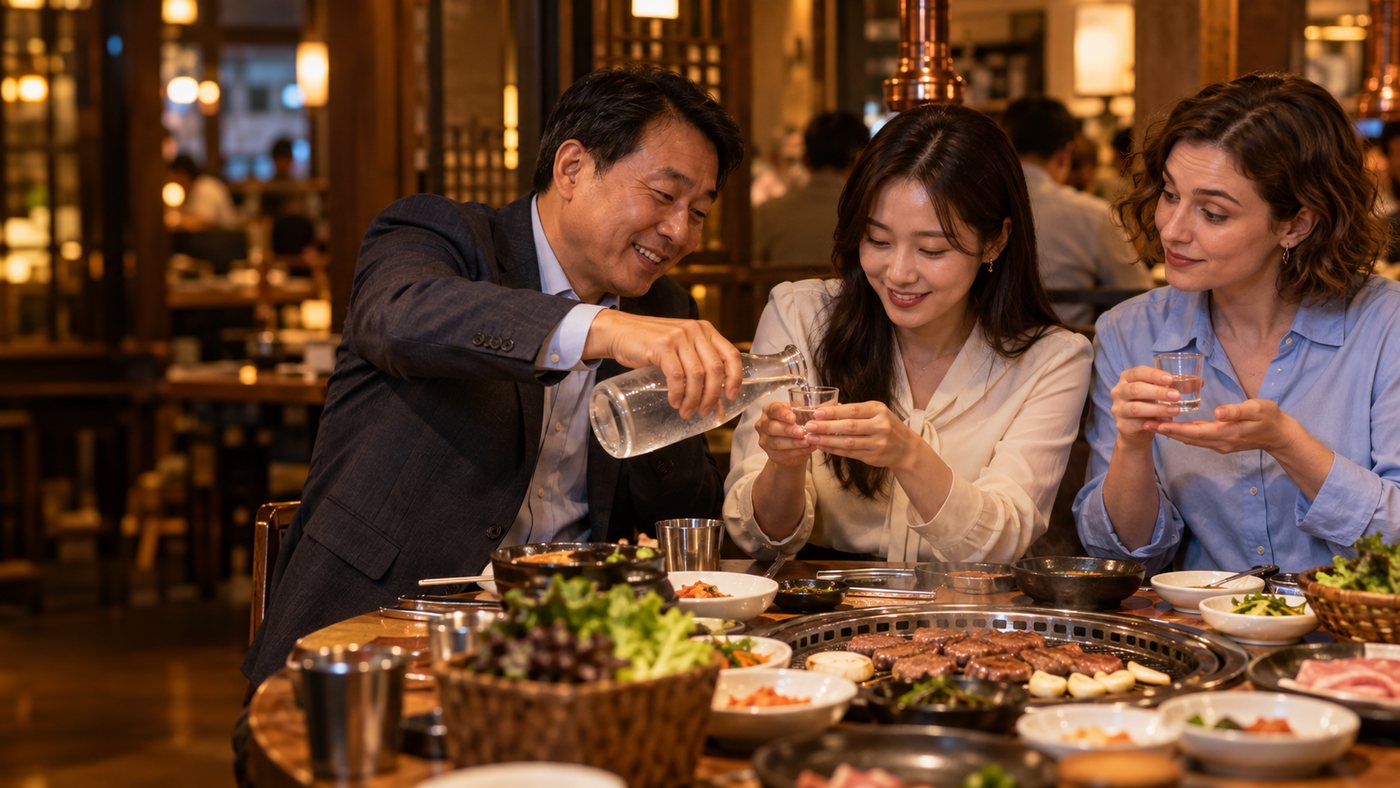
In Korean workplaces and schools, people are called by their job titles, there are hoesik (company get-togethers), and sunbae-hubae (senior-junior) relationships matter. Here are the 12 questions foreigners ask most, with the reasons behind them and what you can do.
As of October 2026 — it may differ depending on the company, school and generation.
Once you start working or studying in Korea, you and your foreign colleagues tend to talk about the same things. "Why do they use job titles instead of names?", "Do I really have to go to hoesik?", "Do I have to answer KakaoTalk messages after work?" This article picks 12 of those questions and explains why it is that way and what makes things easier for you. Atmospheres differ a lot between companies and schools, so please read the explanations below as "this is often the case."
| Situation | Common reason | Try this |
|---|---|---|
| People use job titles instead of names | It's a culture where people call each other by rank and role | Ask at the start, "What should I call you?" |
| It feels awkward to leave before the boss | Some places still have an atmosphere of staying until the boss leaves | Say "I'll head out first" and leave |
| It feels like you have to go to hoesik | It's seen as a time to build team spirit | Join the first one, and decline drinks comfortably |
| Lunch is also eaten together | Eating together is a way to get closer | It's okay to eat alone sometimes |
| They say "I'll review it" (geomto hae bolge-yo) | It usually means exactly that: they will look into it | Say, "If there's anything you'd like to tell me after reviewing, please let me know" |
| It feels awkward to use annual leave | These days, if you hand over your work well, people tend to be fine with it | Let them know in advance and hand over your work |
| You feel left out because you don't speak Korean | Meetings, lunch conversations and group chats are in Korean | Show that you're making an effort to learn Korean |
| A boss yells at you | Workplace harassment is banned by law | Keep records and find out where to report |
| Group projects (timpeul) feel stressful | Matching opinions and schedules is hard for everyone | Offer a role you can take on first |
| Can I ask the professor questions? | Most professors welcome questions | Feel free to ask during class too |
| Sunbae-hubae, MT and dongari feel unfamiliar | Sunbae-hubae is a strong network built on mutual respect | Understand the culture and background, and adjust to it |
| An English-taught course is held in Korean | It happens when there are few foreign students | Ask the professor before you register |
In Korean companies, people are often called by their name followed by a job title, like "Kim Teamjang-nim" (Team Leader Kim) or "Park Gwajang-nim" (Manager Park). Using someone's name on its own is mostly for very close relationships or when the other person is junior to you. It's a way of showing mutual respect, so there's no need to feel it's rude.
Rank (jikgeup, a hierarchy level such as gwajang or daeri) and position (jikchaek, a role you hold such as teamjang, team leader) are different things. In small companies and startups, rank distinctions are simpler, and some places call each other "○○-nim" or by English names.
The easiest way is to ask on your first day, "What should I call you?" For colleagues, adding "-ssi" or "-nim" after the name is safe. For people senior to you, skip "-ssi" and add "-nim" to their job title instead.
By law, the working time limit is 52 hours a week: 40 hours plus up to 12 hours of overtime. Even so, depending on the company or industry, there is still an atmosphere in some places where it's hard to leave before your boss does. This is becoming less common, but it varies a lot from company to company.
If you work overtime, the rule at workplaces with 5 or more employees is that you receive an extra 50% on top of your ordinary wage. However, if your contract is a pogwal-imgeum-je (a wage contract with fixed overtime pay included), where the employment contract says "fixed overtime pay included," things may be different, so be sure to check your contract.
When your work is done, say "I'll head out first" and leave. Even a single greeting makes the mood much softer. You can read more about employment contracts and wages in the Employment Contract Guide.
Hoesik (hoe-sik) is when a team eats or drinks together. In Korea, many people believe you get closer when you spend time together without talking about work, so it's seen as a time to build team spirit. It can also continue in order: first round (a meal), second round (drinks or a cafe), then karaoke (noraebang).
Things are changing these days. More places end early or hold a lunch hoesik instead of dinner. The pressure to drink has also eased a lot compared to the past. Still, it varies a great deal by department and company.
Going to the first hoesik is good for building relationships. If you don't drink, say briefly and clearly at the start, "I don't drink," and keep a non-alcoholic drink in your glass. People then tend to offer you drinks less often. You can usually skip the second round freely. When an elder pours you a drink, it's polite to receive it with both hands and turn your head slightly to the side as you drink.
Many companies have team members eat lunch together. You'll also often see the scene where everyone says "anything is fine" (amugeona) when choosing a menu and time slips away. Because it's time to get closer over food, skipping it often can make it harder to fit in.
That said, you don't have to eat together every day. Eating alone sometimes, or saying you have plans, is mostly fine.
If there are foods you don't eat or you have an allergy, let people know once at the beginning. Then they will take it into account when choosing a menu.
Koreans tend to express their intentions relatively directly. If something is good, they say it's good; if not, they say it's not, so the other person can understand. That's why, in Korea, it's important to speak politely, but also directly. The same goes for when you disagree.
The phrase "I'll review it" generally means they will really review it, just as it says. Some people do use it to turn something down carefully, but that isn't common. Of course, it can change depending on the atmosphere and tone of voice.
When you hear "I'll review it," it helps to say, "If there's anything you'd like to tell me after reviewing, please let me know." If an answer feels vague, ask once more: "Then may I go ahead in this direction?"
Annual leave is a right guaranteed by law. If you've worked under a year, you earn 1 day for each month you attend in full, and if you attend 80% or more over a year, you get 15 days. These days, the mood in Korea is moving toward using it without worrying, as long as you hand over your work well. In many cases, unused leave can be paid out as an allowance.
Most Koreans also try to avoid sending work KakaoTalk messages after work or on days off. If someone keeps sending non-urgent things outside work hours, that's not a feature of Korean culture, it's that person's own personality.
If someone contacts you after work, first check whether it's urgent. You can say, "Is it urgent? If not, I'll check it tomorrow when I get in." If you let people know about your annual leave in advance and hand over your work before taking it, there's almost nothing to worry about.
When meetings, lunch conversations and group chats all run in Korean, people who aren't comfortable in Korean can easily miss information. It's less about ill will and more something that happens because it's a workplace that runs in Korean.
If you work with Koreans, learning Korean is the surest way. Even if you're not good yet, showing that you want to learn Korean makes most colleagues think well of you and want to help. At first, start with the phrases often used at work and the expressions used in group chats.
Yelling or insulting people is not acceptable in Korean workplaces either. Since 2019, a ban on workplace harassment has been part of the Labor Standards Act, and it applies equally to foreign workers.
For changing workplaces or unpaid wages, the procedure differs depending on your visa type. Also take a look at the Employment Insurance & Industrial Accident Insurance Guide.
University classes have a lot of team projects (timpeul). Once teams are set, a group chat is made and you decide the schedule and roles. Foreigners aren't the only ones who feel the pressure at this point. Most Korean students find timpeul stressful too.
The jojang (group leader), who leads the team, carries a heavy burden because they have to coordinate the schedule and look after everyone. The other members have their own difficulties depending on their roles. Above all, it's hard to match everyone's opinions and schedules.
This isn't so much a trait that differs by country; it's more similar than different. In any country, someone becomes the leader and the members each play their part accordingly. Since work is done in teams after you enter society, it's important to build up good group-project experience at school.
At the first meeting, be honest about your Korean level, and offer a role you feel confident in first, such as doing research or making the presentation slides. If you finish your part by the agreed date, trust builds quickly.
Yes, that's fine. Most professors like it when students ask questions, because it tells them someone is really listening to their lecture. In many cases they are even happier when a foreign student asks.
Sunbae-hubae (seniors and juniors) is less like an equal friendship and closer to a relationship in which each side owes the other courtesy. In Korea, where age matters for how you speak, juniors (hubae) use polite speech to seniors (sunbae), and seniors often look after their juniors.
There is also a historical background of strong solidarity behind this. In Korea, a culture of joining forces took firm root as people farmed together and defended against foreign invasions together. That's why school sunbae-hubae become one strong network too. MT (short for "membership training"), an event where a department or club spends a night together, is also a place to build this kind of relationship. This can feel unfamiliar to foreigners.
Dongari (clubs) are groups that gather around shared interests or hobbies, so there are plenty of them abroad too. However, the way people build relationships within a dongari may feel unfamiliar.
This isn't a problem with one right solution. If you live in Korea, the most natural way is to understand the cultural and historical background and adjust to it as you get along with Koreans.
When there are few foreign students, a course opened as English-taught can still be run in Korean. It's something foreign students often run into. If the lecture is fast or mixed with dialect, it can be even harder to keep up.
Check the syllabus before you register, and if you're not sure, email the professor to ask. After the class starts, it helps to get the slides in advance and ask permission to record. Studying with a Korean friend from the same class is also a good idea.
| Place | One thing to remember |
|---|---|
| Workplace | Use job titles, always say a quick word when leaving, speak directly but politely, and show you're trying to learn Korean |
| Hoesik | Join the first one, and decline drinks comfortably |
| School | Offer a role you can take on first, and feel free to ask questions during class |
This article summarizes general tendencies, so it may differ depending on the company, school and generation. If you're curious about everyday questions, also read Why Do Koreans Ask Your Age First? 12 Everyday Korea Questions Foreigners Ask Most.