
Taejongdae Haenyeochon — a mixed seafood plate
It’s inside Busan’s most famous tourist spot, yet almost no foreign reviews mention it — we checked whether the scene from 30 years ago is still there.
As of September 2026
Taejongdae Haenyeochon — a mixed seafood plate
If you’ve been to Busan a few times over the years, you might remember it — at the foot of a cliff, ajummas with sea squirt, sea cucumber, and spoon worm (gaebul, 개불) in red rubber basins, slicing it right there on the spot.
Taejongdae is already on nearly every Busan itinerary. And yet, oddly enough, reviews from foreign visitors who actually bought and ate this seafood are almost impossible to find. Everyone sees the cliffs and the lighthouse, then walks right past what’s underneath.
"Is it still there?" you might be wondering. It is. Same as ever. Its official name is Taejongdae Haenyeochon (Taejongdae Haenyeo Village).
Roughly, here’s what’s on offer.
If you’ve only ever eaten cooked seafood, this will honestly be a big challenge — squirming octopus, unfamiliar textures, and a strong ocean smell, all arriving at once.
But if you’re someone who enjoys pushing into something new, this can become one of the most memorable moments of your whole trip. You’re eating something that was alive moments ago, with the sound of waves right next to you.
It’s usually paired with Korean soju — exactly how Koreans themselves do it.
Koreans are so used to eating raw seafood that plenty of them genuinely love it. But even among Koreans, sea squirt is a real love-it-or-hate-it item — its intensely oceanic smell (closer to iodine) means quite a few people can’t stand it either. So if you try a bite of sea squirt and it’s not for you, don’t assume something’s wrong with your palate — Koreans are split right down the middle on this one too.
It’s not just the outfits — these are genuine haenyeo (traditional Korean women divers). According to a Korea Maritime and Ocean University survey, Yeongdo’s haenyeo dive at just two main spots, and this stretch of coast near the Taejongdae Jagalmadang (a jagalmadang is a pebble-yard stall area) is one of them.
Most of the vendors are older grandmothers, and one striking detail is that they prep the seafood wearing the same red rubber gloves you’ll see at any Korean restaurant or market. It’s such a common sight across Korea that locals barely notice it — but for a foreign visitor, it’s likely to stand out as something fresh and new.
Walk down the stairs from the observatory toward the lighthouse, and you’ll find open-air stalls run by haenyeo grandmothers. Pick what you want, they slice it on the spot, and you sit in a plastic tent right beside it, eating with a view of the sea.
One Western travel blog review we found describes it as — "inside a warm tent, with the blue sea right there, seeing a live fish for the first time." A lot of the tone leaned toward novelty and romance.
Based on visitor accounts, a plate of turban shell and octopus ran about KRW 50,000 (this can vary with the season and catch).
To a Korean who has plenty of seafood markets and raw-fish restaurants to compare against, this isn’t especially good value — there are cheaper places around Busan serving similar things.
But if the ingredients themselves are unfamiliar and your sense of what things "should" cost is calibrated elsewhere, it reads differently. It’s probably more accurate to think of the price as covering not just "how much is this food," but the seat and the experience of eating it with the sea right at the foot of a cliff.

Taejongdae Lighthouse — you can spot the haenyeo village’s tents right at the base of the cliff.
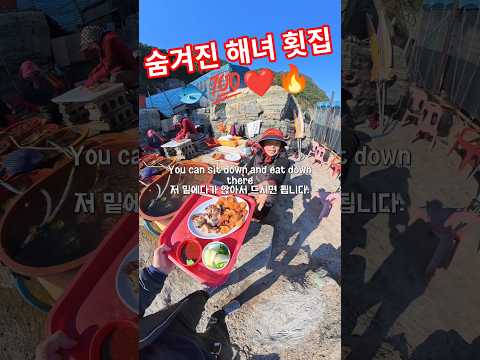 A hidden haenyeo seafood spot at Taejongdae, Busan (Shorts)
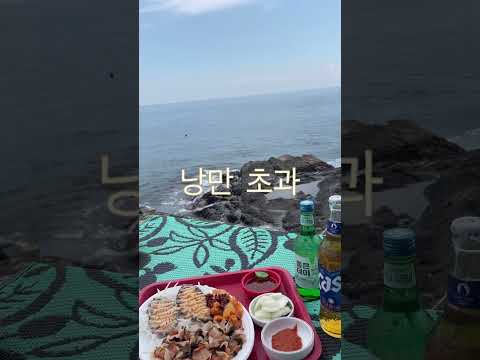 A Taejongdae seafood stall as seen on Korean TV (Shorts)
 "Welcome, First Time in Korea?" Busan episode — opens right at the Taejongdae hidden spot
Location — the coastal stalls below the lighthouse (mostly raw seafood)
Near the entrance to Taejongdae Resort Park, at 81 Gamjihaebyeon-gil, there’s a second jagalmadang. This one is mostly cooked food rather than raw — scallop and fan mussel grills, grilled abalone, grilled eel, grilled shrimp, and seafood ramyeon are all on offer. If raw seafood feels like too much, this is the easier option.
Rows of tented stalls line the area, and there’s a small beach right beside it. Like Huinnyeoul Culture Village, it looks out over Busan’s western sea, which makes it especially nice around sunset.
In fact, thanks to its less-intimidating grilled-clam menu, this spot gets mentioned more often in Western travel blogs and reviews than the raw-seafood haenyeo stalls by the lighthouse — it has reviews on Tripadvisor, and the travel platform NOL even has its own dedicated page for it.


Gamji Beach Jagalmadang — a grilled shellfish platter (left), seafood ramyeon (right)
Location
How to get there
Both routes take you to the entrance of Taejongdae Resort Park — from there, the Danubi Train or a walk gets you to the lighthouse and the jagalmadang.
Prices and hours can shift with the season and catch. Worth double-checking before you visit.