Photo: Busan Tourism Archive (부산관광아카이브)
Here are five signature Busan foods worth trying. For pork soup rice (dwaeji gukbap) and milmyeon, we link you to guides we have already written. For Dongnae pajeon, fish cake (eomuk) and nakgopsae, we cover where each came from, how to order and how to eat it.
As of October 23, 2026 — Opening days and menus may change. Check before you go.
Photo: Busan Tourism Archive (부산관광아카이브)
The Busan Tourism Organization has long presented pork soup rice (dwaeji gukbap, 돼지국밥), Dongnae pajeon (동래파전), milmyeon (밀면), fish cake (eomuk, 어묵) and nakgopsae (낙곱새) as the foods that represent Busan.
In this guide we introduce the first two briefly and link you to the guides we have already written. For Dongnae pajeon, fish cake and nakgopsae, we cover where each one began, how to order and eat it, and whether any unfamiliar ingredients are involved.
Pork soup rice (dwaeji gukbap, 돼지국밥) is a rice soup made with a broth simmered from pork bones, served with rice and slices of pork. It is also the Busan food that foreign visitors to Busan named most often. For the story behind it, read Dwaeji Gukbap, Busan's Pork Soup: The Dish a War Left Behind. If you want help choosing a shop, see 20 Dwaeji Gukbap Spots, Picked by Busan Locals.
Milmyeon (밀면) is a Busan noodle dish made with wheat-flour noodles and served cold. With the soup version (mul milmyeon, 물밀면), take a sip of the broth first, then add vinegar and mustard to suit your taste. The full explanation is in Milmyeon, Busan's Wheat Cold Noodles: How It Differs from Naengmyeon.
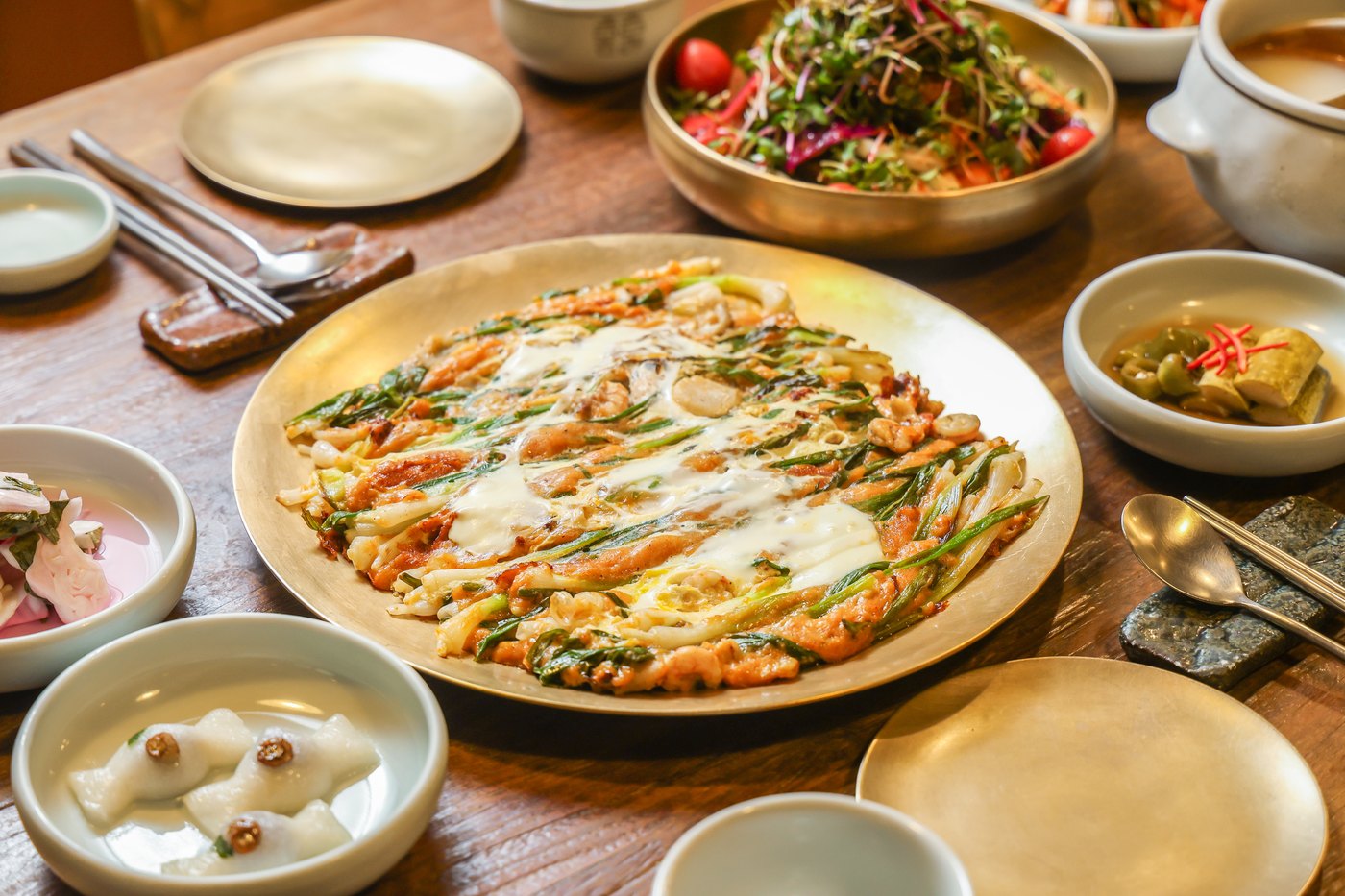
Dongnae pajeon (동래파전) is a savory pancake (jeon) made by pan-frying small green onions (jjokpa) and several kinds of seafood in a batter of non-glutinous rice flour mixed with glutinous rice flour. It is a local specialty of Dongnae-gu (동래구) in Busan, and it is said to be the one that best keeps its local character among the local dishes selected by the city of Busan.
Where did it come from? In the Joseon era, Dongnae-bu (동래부) was a center of the economy and diplomacy. Two stories are told about how Dongnae pajeon began: one says it started as an everyday meal for ordinary people, the other says it started as an upscale food to go with drinks. The second story is more widely accepted.
What does it taste like? It is known for a moist, soft texture, and it is packed with ingredients.
What goes in it? Green onions and water dropwort (minari, 미나리) go in with seafood such as clams, mussels, shrimp and oysters, and beef and egg are added too. Some shops use a batter of glutinous and non-glutinous rice flour mixed with a stock made from dried anchovies and kelp. The ingredients vary a little from shop to shop.
Allergies and vegetarian diets: Dongnae pajeon contains seafood, beef and egg. If you have a seafood or egg allergy, or you are vegetarian, you cannot eat it. Ingredients differ from shop to shop, so ask before you order.
Where can I eat it? Dongnae Halmae Pajeon (동래할매파전), now in its fourth generation, is featured on Visit Busan (비짓부산), the official tourism portal of the city of Busan. The address is Myeongnyun-ro 94beon-gil 43-10 (명륜로94번길 43-10), Dongnae-gu, and it is closed on Mondays. Visit Busan lists two sizes, so choose according to the number of people in your group.
How to find a restaurant: In your map app, search for 동래파전 (Dongnae pajeon) and 해물파전 (haemul pajeon, seafood pajeon) separately.
These two are not really very different dishes. They are simply two search terms for finding restaurants. If we have to name a difference, haemul pajeon (해물파전) is usually a pajeon with more seafood than a regular pajeon, and how it is served depends on each shop's menu.
On the map, you will see that many of the restaurants that come up are near Dongnae Station (동래역), where subway Line 1 and Line 4 meet. Many kalguksu (칼국수, knife-cut noodle soup) restaurants also sell pajeon, so keep an eye out for kalguksu shops too.
Opening days and menus may change, so check before you go.
Fish cake (eomuk, 어묵) is made by grinding fish meat, mixing it with a flour-based batter and other ingredients, and then frying or steaming it. It traces back to Japan's kamaboko (fish paste cake) and oden. During the Japanese colonial period (일제강점기), factories were set up in Busan, a port city close to Japan. After Korea's liberation in 1945, the recipe was adapted to Korean tastes and became today's Busan-style eomuk.
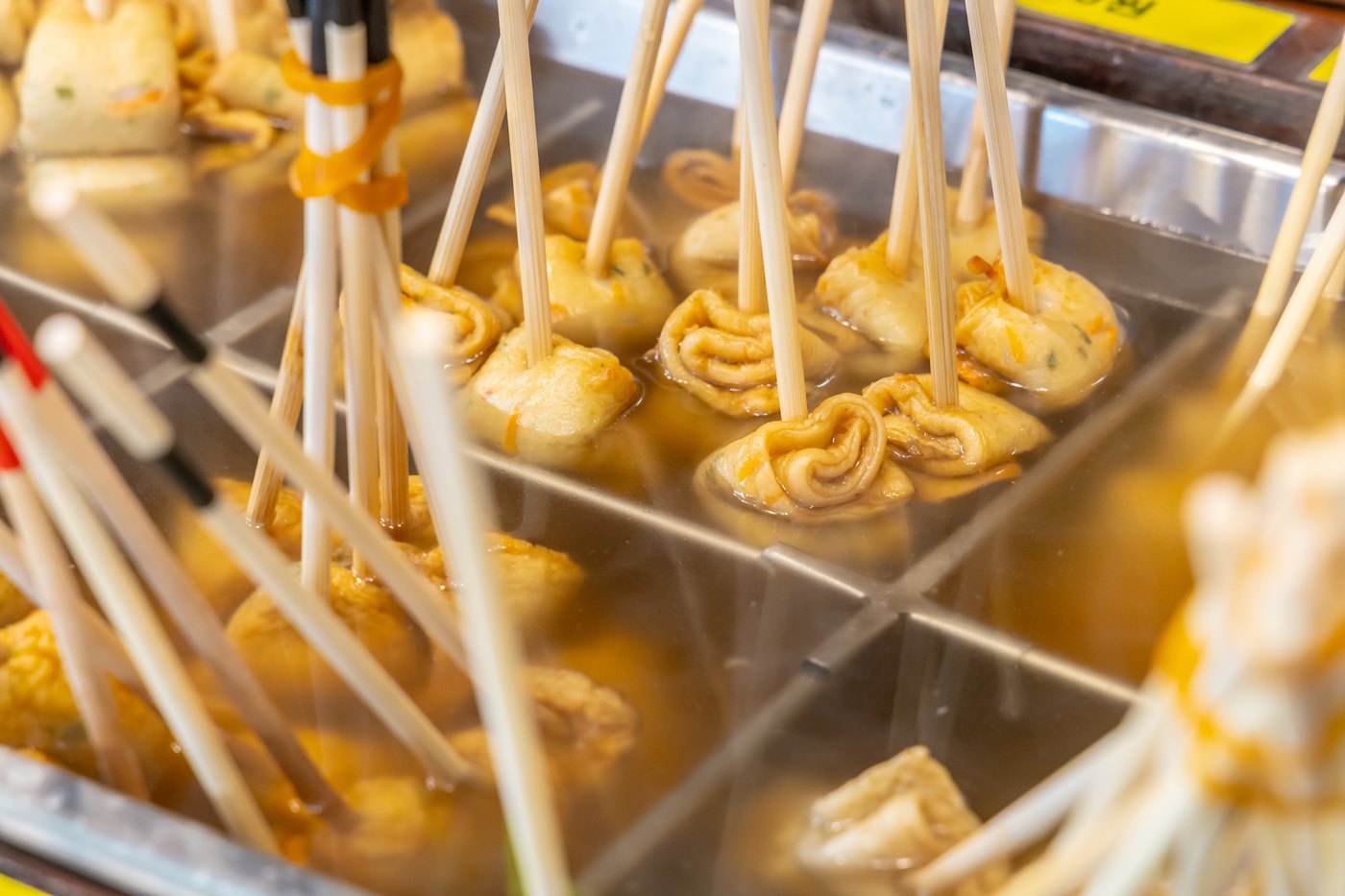
Photo: Busan Tourism Archive (부산관광아카이브)
You can easily buy fish cake anywhere in Korea. Even so, Busan is the city where Korea's fish cake industry began and grew, so it is counted among Busan's signature foods.
Why Busan fish cake is famous: The city of Busan says that many Busan makers use up to 70% fish meat. In other regions, 50 to 60% is said to be usual. The rest is ingredients such as starch, flour and vegetables.
It is used in many dishes: Fish cake is known as street food eaten standing up, but it is also used in many other dishes, such as japchae (잡채, stir-fried glass noodles), tteokbokki (떡볶이, spicy rice cakes) and eomuk-tang (어묵탕, fish cake soup).
How do you eat it? At street stalls, fish cakes threaded on skewers sit in warm broth. Most stalls give you the broth for free in a paper cup.
Many people also eat multteok (물떡, 'water rice cake') along with fish cake. It is a long skewer of rice cake that you dip in the fish cake broth. It is said to have been eaten at Busan bunsik (분식, Korean snack food) stalls since the 1960s.
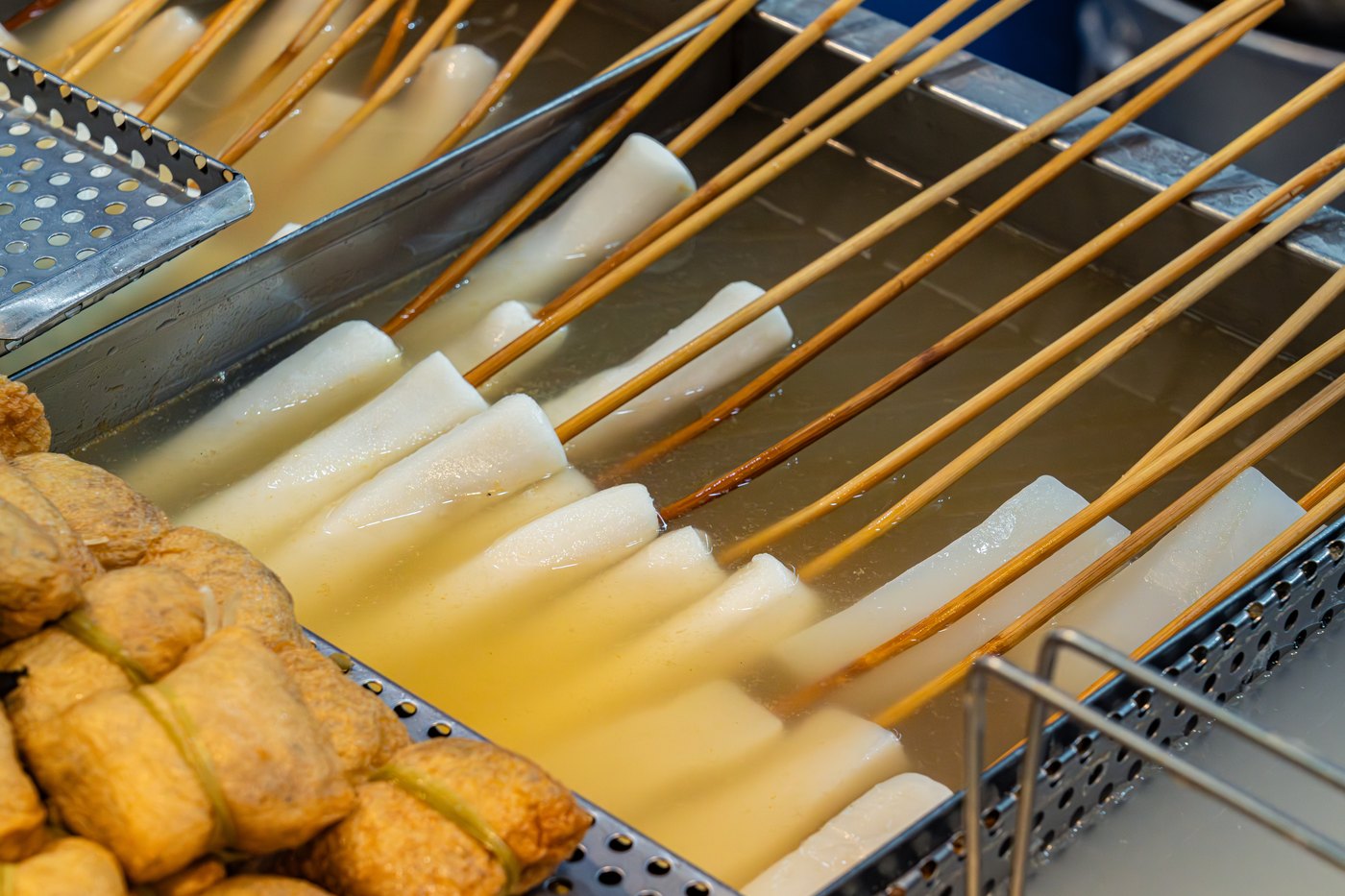
Photo: Busan Tourism Archive (부산관광아카이브)
Bring cash: Street stalls often do not accept cards.
Where can I eat it? The city of Busan says that to taste real Busan fish cake, you should head to the stalls at Jagalchi Market (자갈치시장) or Bujeon Market (부전시장). Long lines form to buy fish cake.
If you are going to Jagalchi Market, see also How to actually eat hoe at Jagalchi Market.
If you are curious about a fish cake factory shop, there is the Yeongdo (영도) flagship store of Samjin Eomuk (삼진어묵), known as the oldest fish cake maker in Busan. The store looks like a bakery, and on the second floor there is an experience hall where you can make fish cake yourself.
Allergies and vegetarian diets: Fish cake is made from fish meat and contains wheat flour. If you have a fish or wheat allergy, you cannot eat it. Some shops also put crab in the broth, so if you have a shellfish allergy, such as shrimp or crab, be sure to ask before you eat. If you are a vegetarian who eats fish, you can eat fish cake, but what goes into the broth differs from shop to shop, so it is best to ask. If you are a vegetarian who does not eat fish either, you cannot eat fish cake.
Nakgopsae (낙곱새) gets its name from the first syllables of nakji (낙지, small octopus), gopchang (곱창, beef small intestine) and saeu (새우, shrimp). It is a dish that was created in Busan, and it tastes sweet and spicy.
Each ingredient has its own texture, which makes every bite interesting. It also goes well with alcohol, so many people eat it as a drinking snack (anju, 안주).
Its roots are in Jobang nakji (조방낙지). Nakgopsae came from a Busan-style stir-fried octopus called 'Jobang nakji' (조방낙지). 'Jobang' is short for Joseon Bangjik (조선방직), a textile mill that stood around today's Jayu Market (자유시장) in Beomil-dong (범일동), Dong-gu (동구), Busan.
It is said to have started with a stir-fried octopus shop in front of the factory gate. It was a place where workers stopped by on their way home from work and relieved the day's fatigue with a drink and octopus.
At first, they say, the octopus was simply boiled and served as a drinking snack. When customers began asking for it to be seasoned, red chili powder seasoning was added, and that became today's spicy stir-fried octopus. A shop that opened in 1963 is known as the beginning of it.
In the 1990s, the stir-fried octopus alley became famous across the country. Today there is a Jobang nakji street around Pyeonghwa Market (평화시장) and Jayu Market (자유시장) in Beomcheon-dong (범천동).
The menu is split into versions. Many restaurants like this sell separate menu items: octopus only (nak, 낙), naksae (낙새, octopus and shrimp), nakgop (낙곱, octopus and beef intestine) and nakgopsae (낙곱새, all three). If you want to leave out the intestine or the shrimp, just choose by the name.
How is it served? Every table has a burner. Onions and green onions are laid in a frying pan and the octopus goes on top. Chili powder seasoning paste and minced garlic go on next, then just enough seafood broth is poured in to leave a little liquid in the pan, and it is brought to a boil over high heat.
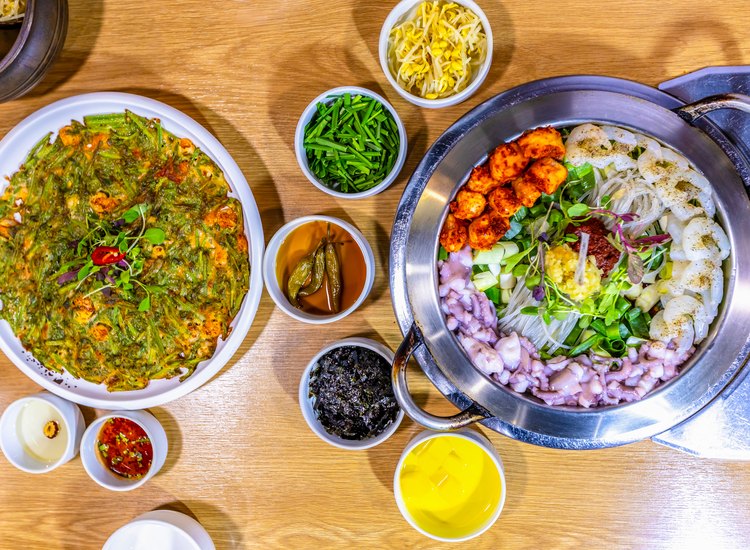
Photo: Busan Tourism Archive (부산관광아카이브)
When it comes to a boil, add more broth and cook over low heat, stirring as it cooks. It is a stir-fry that keeps a little sauce in the pan.
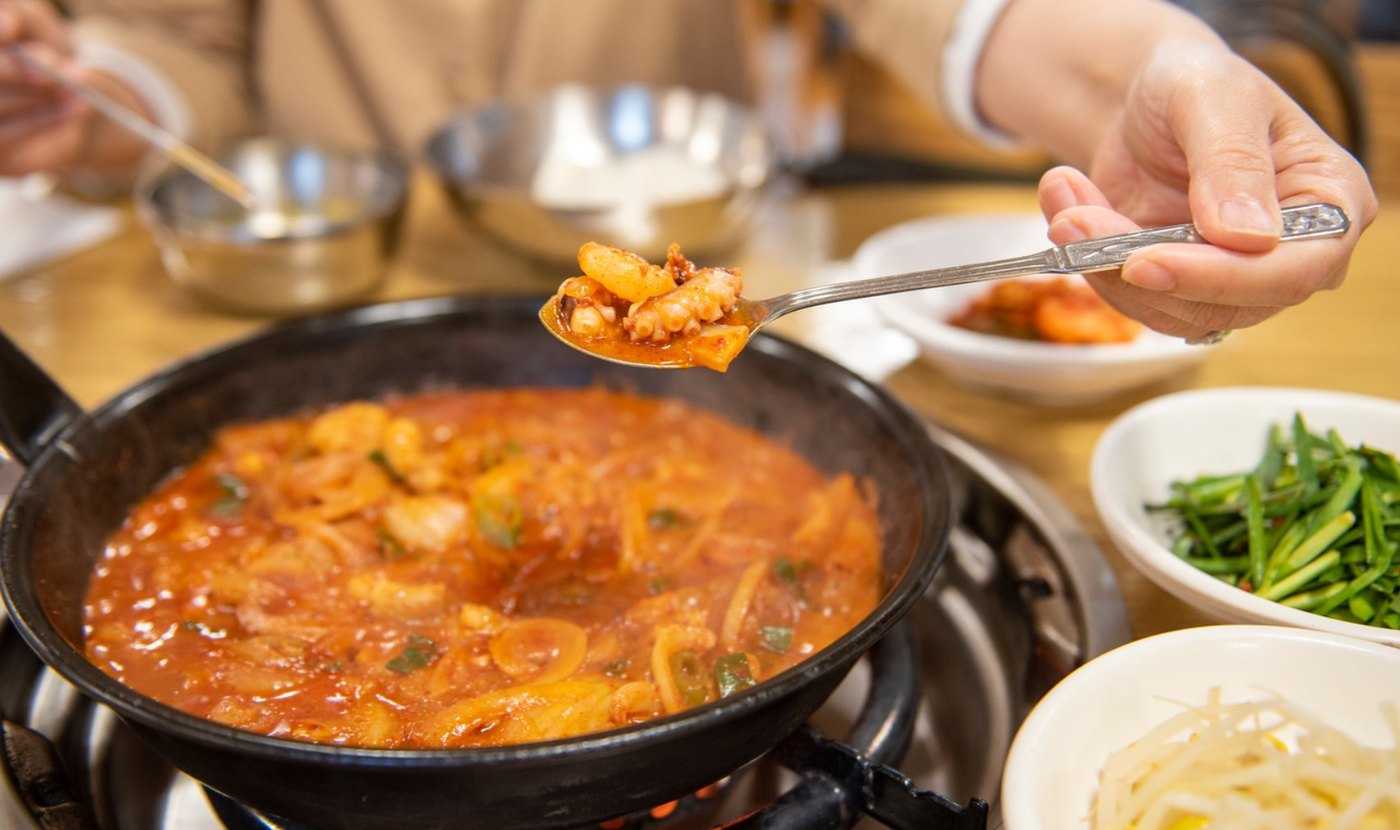
Photo: Busan Tourism Archive (부산관광아카이브)
What makes the flavor special? In Busan, chili powder seasoning is used instead of gochujang (chili paste). The broth is made from seafood such as shrimp, clams and anchovies. So the sauce is not thick, and the flavor is clean and light.
Many people mix it with plain white rice. Steamed rice and add-ins (sari, 사리: glass noodles, udon, ramen noodles) are sometimes sold separately at each shop, so check the menu.
If you are unsure about the intestine: The gopchang (곱창) in nakgopsae is beef small intestine. Some people find organ meat hard to take, so look at the menu first. If you do not like it, ask whether there is a version without the intestine (nakji-bokkeum, 낙지볶음, stir-fried octopus, or naksae, 낙새, and so on).
Allergies and diet: It contains octopus, shrimp and beef intestine, and the broth also uses shrimp, clams and anchovies. If you have a shellfish (crustacean or mollusk) or fish allergy, be sure to ask before you order. If you do not eat beef, avoid nakgop (낙곱) and nakgopsae (낙곱새), which contain the intestine.
Where can I eat it? Search for '낙곱새' (nakgopsae) on the map. There are many restaurants all over Busan that serve nakgopsae.
If you want to feel the original atmosphere, there is also the Jobang nakji (조방낙지) restaurant area around Beomil-dong and Beomcheon-dong.