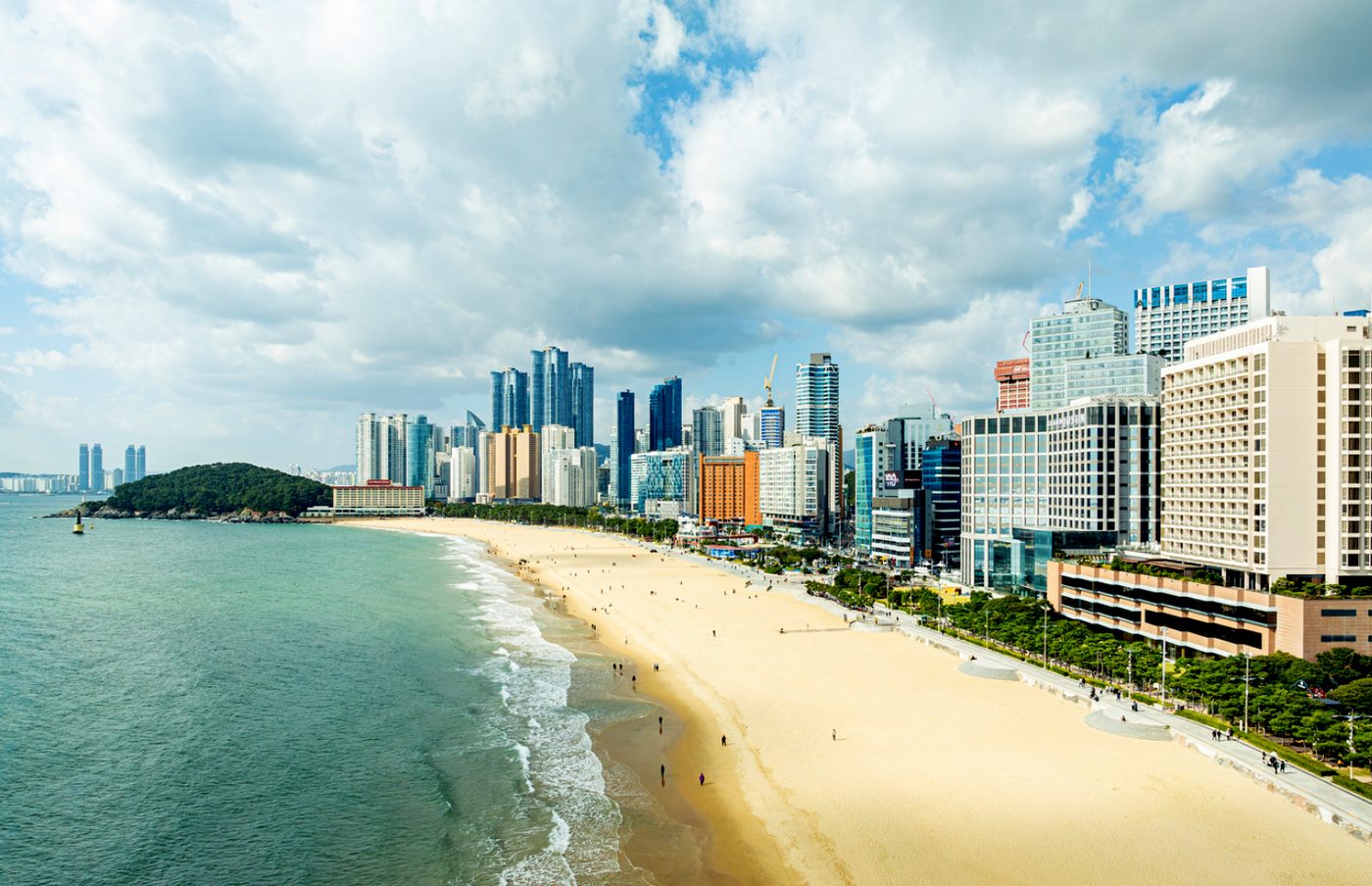
Haeundae — Busan Tourism Archive (부산관광아카이브) · KOGL Type 1
Haeundae is not one beach but a long stretch from Dongbaek Island in the west to Cheongsapo in the east. If you do not know where to start and where to end, it is easy to backtrack, so this guide lays out an order that works for one day.
As of October 15, 2026 — check operating hours, fares and closing days on the official sites again before you visit.
This page contains affiliate links. If you book through one, K-Rambles may earn a commission — at no extra cost to you.
Haeundae — Busan Tourism Archive (부산관광아카이브) · KOGL Type 1
| Item | Details |
|---|---|
| Route | West: Dongbaek Island (동백섬) and Nurimaru → middle: Haeundae Beach → east: Mipo, Blue Line Park and Cheongsapo |
| Cost | Dongbaek Island, Nurimaru, the beach and Dalmaji-gil are free. Blue Line Park is paid (booking recommended) |
| Check ahead | Blue Line Park booking, Nurimaru closing day (first Monday of every month), Blue Line Park last-ride time |
| Nearest subway | Line 2: Dongbaek Station (Dongbaek Island), Haeundae Station (beach), Jungdong Station (Mipo) |
Haeundae is not just one beach. The sand runs about 1.5 km (30–50 m wide). At its west end is Dongbaek Island (동백섬); at its east end are Mipo (미포) and Dalmaji-gil (달맞이길), and beyond them Cheongsapo (청사포). If you get off the subway and only see the beach, you have seen half of it.
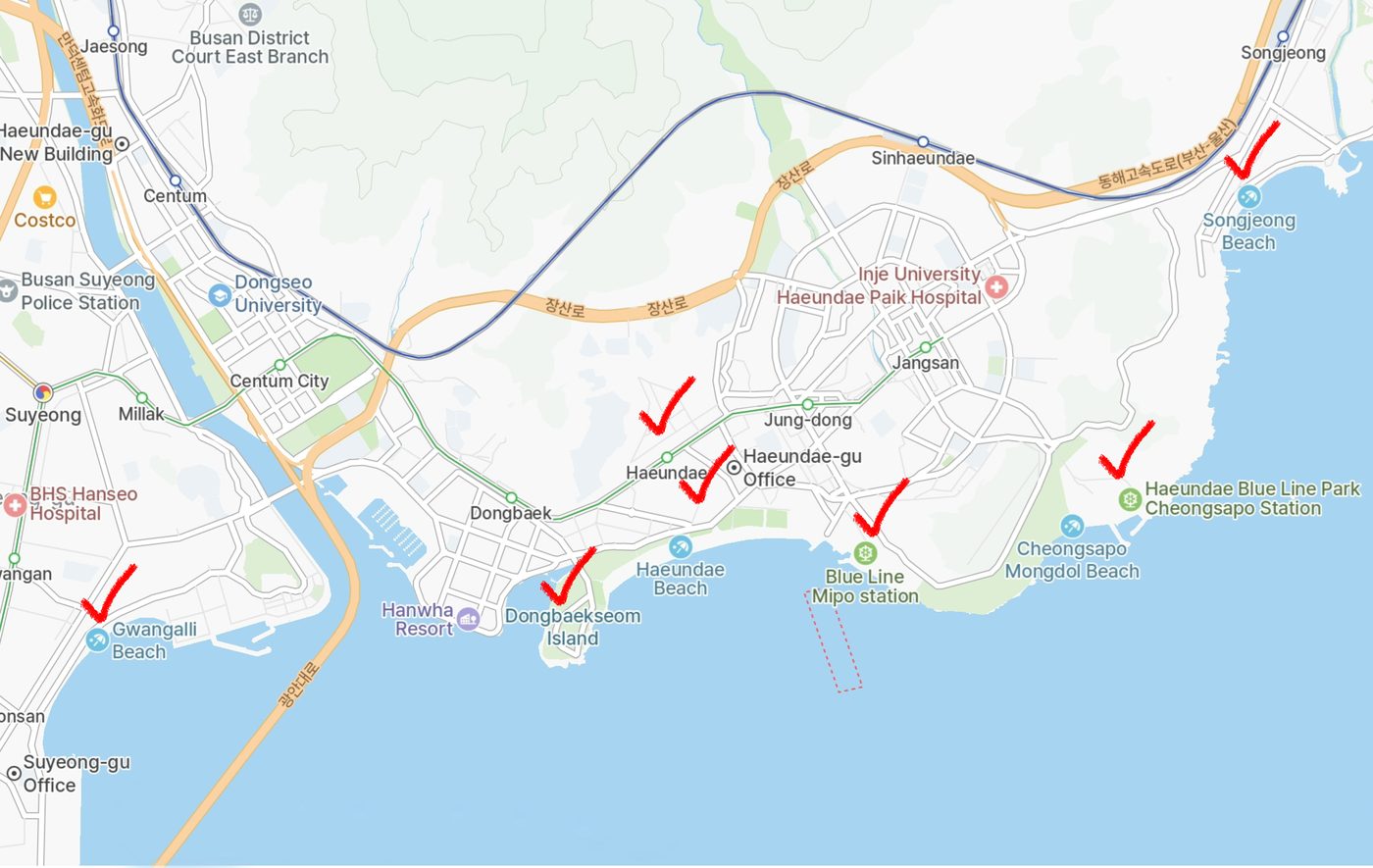
| Area | Main places | Nearest subway |
|---|---|---|
| West | Dongbaek Island, Nurimaru APEC House (누리마루 APEC하우스) | Dongbaek Station (동백역) Exit 1, 15–20 min on foot |
| Middle | Haeundae Beach (해운대해수욕장) | Haeundae Station (해운대역) Exit 3 or Exit 5 |
| East | Mipo, Blue Line Park, Dalmaji-gil | Jungdong Station (중동역) Exit 7, about 15 min on foot |
| Farther east | Cheongsapo | Jangsan Station (장산역) Exit 7 + village bus |
This guide follows one direction, from west to east. If you keep going the same way, you hardly ever have to backtrack. For how to get from the airport to Haeundae, see Gimhae Airport to Haeundae: How to Get There.
Dongbaek Island (Dongbaekseom, 동백섬) is a small wooded island at the west end of the beach. As the name suggests, it has many camellia trees (dongbaek), and a walking path runs along the water. From the lighthouse plaza in the middle you can see Nurimaru and the Gwangan Bridge together. It is open year-round and free.
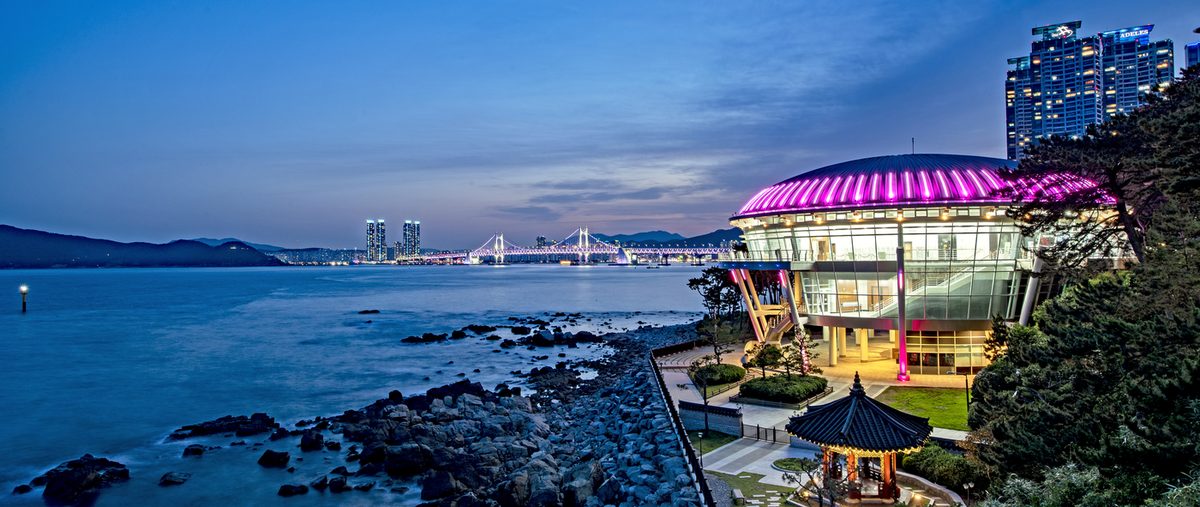
Nurimaru APEC House (누리마루 APEC하우스) is the building where the 2005 APEC summit was held in Busan. Nurimaru means “the summit of the world,” a name taken from the idea of world leaders gathering there. It is now a memorial hall, and entry is free.
The key to understanding this building is the jeongja (정자, 亭子). A jeongja is a traditional Korean pavilion built with only pillars and a roof, no walls, set in a scenic spot where people rested, gathered and looked at the view. You often see them beside palace ponds in Seoul or halfway up mountains. Nurimaru reinterprets the jeongja as a modern building.
| Traditional jeongja | Nurimaru |
|---|---|
| Raised off the ground, open on all sides | Building lifted on pillars (pilotis) |
| The roof is the face | Roof that echoes the slope of Dongbaek Island |
| Dancheong colors | Dancheong-like colors, traditional decoration |
| A place to look at the view | Terrace facing Oryukdo and the Gwangan Bridge |
The designers say they wanted a feeling like “a farm shelter or pavilion nestled in a pine forest.” They tried to bring the spirit of Korean house-building to a meeting hall. Inside, you can see the summit room and a commemorative exhibition.
| Item | Details |
|---|---|
| Opening hours | 09:00–18:00 (last entry 17:00) |
| Closed | First Monday of every month |
| Admission | Free |
Location — Nurimaru APEC House, 116 Dongbaek-ro, Haeundae-gu
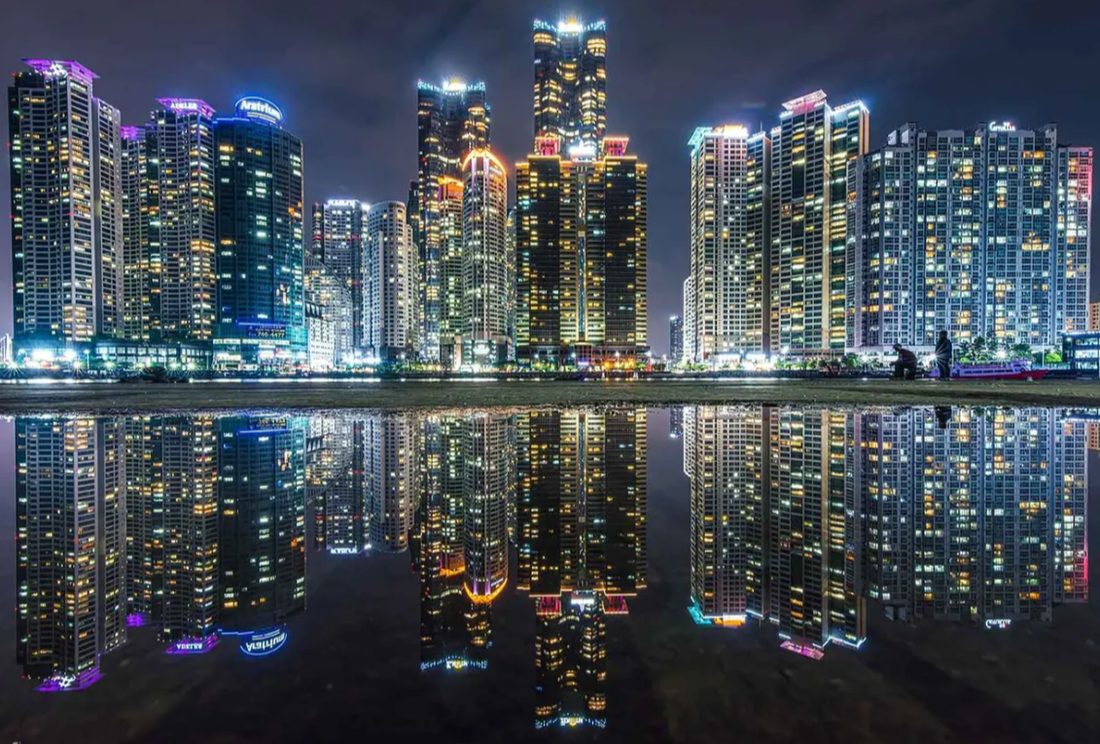
Looking west, you see a forest of tall buildings right on the water. This is Marine City (마린시티). It was built on land reclaimed from Suyeong Bay and is mainly residential, so what you see is not offices but super-tall apartment towers lined up along the shore, a scene you will not find in many places.
The Korea Tourism Organization says Marine City’s night view compares with the skylines of Hong Kong and Shanghai. The best time is after dark, when the buildings light up. Nurimaru closes around sunset, so in the evening look at the Gwangan Bridge and Marine City together from the lighthouse plaza on Dongbaek Island.
The Bay 101 (더베이101) is a cultural complex at the entrance to Dongbaek Island. It has restaurants and cafés where you can eat and have coffee while looking at the sea and Haeundae’s city view, so it is a good place to rest before or after walking the island. According to the Korea Tourism Organization it opens 08:00–24:00, and hours differ by shop. It also runs yacht tours.
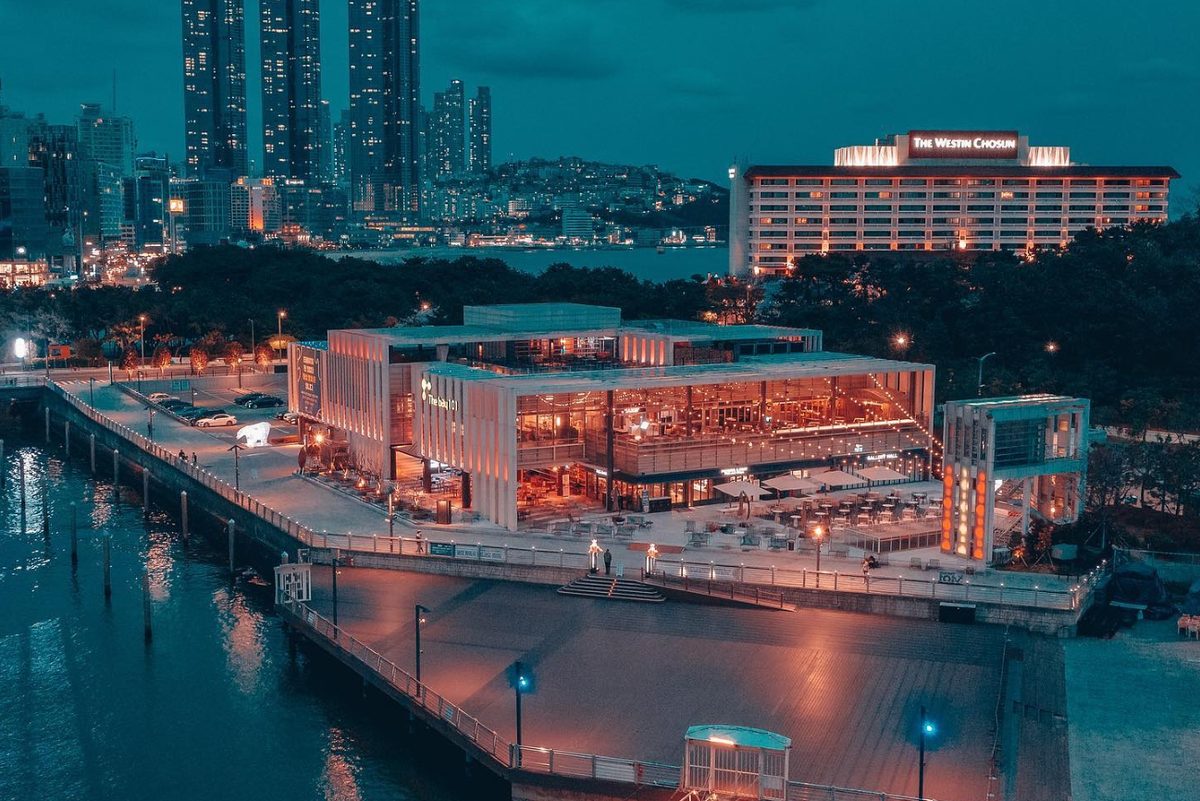
Location — The Bay 101: 52 Dongbaek-ro, Haeundae-gu
The beach is free to enter. Leave Haeundae Station by Exit 3 or Exit 5 and walk toward the sea. The sand runs about 1.5 km from the west end to the east end and is 30–50 m wide.
Haeundae Beach has an official swimming season each year. In 2026 it ran from June 26 to September 15. During this period the swimming area is marked off with buoys, lookout towers are set up, and the district office, private water rescue teams, 119 and the Coast Guard watch over the water as safety staff. Swimming is allowed from 9 a.m. to 6 p.m. Parasols and swim rings can be rented only during this period too.
Outside the season you may legally still enter the sea, but there are no lookout towers and no safety staff, so you are responsible for yourself. If you walk east along the sand, you will reach Mipo.
But the part of Haeundae that is even more fun is behind the sand. A few steps from the beach toward the subway station, there are streets of food and things to see.
| Place | What it is |
|---|---|
| Haeundae Market (해운대시장) | About 5 minutes on foot from the beach. A traditional market with alleys that smell of grilled hagfish, snack stalls with lines, and gukbap restaurants. Usually open 09:00–22:00; hours vary by shop |
| Gunam-ro (구남로) | The wide street linking the beach and Haeundae Station. At Gunam-ro Culture Plaza, events such as flea markets and concerts take place on weekends |
| Haeridan-gil (해리단길) | Residential alleys behind Haeundae Station, full of cafés, international restaurants and small shops (about 4 minutes on foot from Exit 4 of Haeundae Station) |
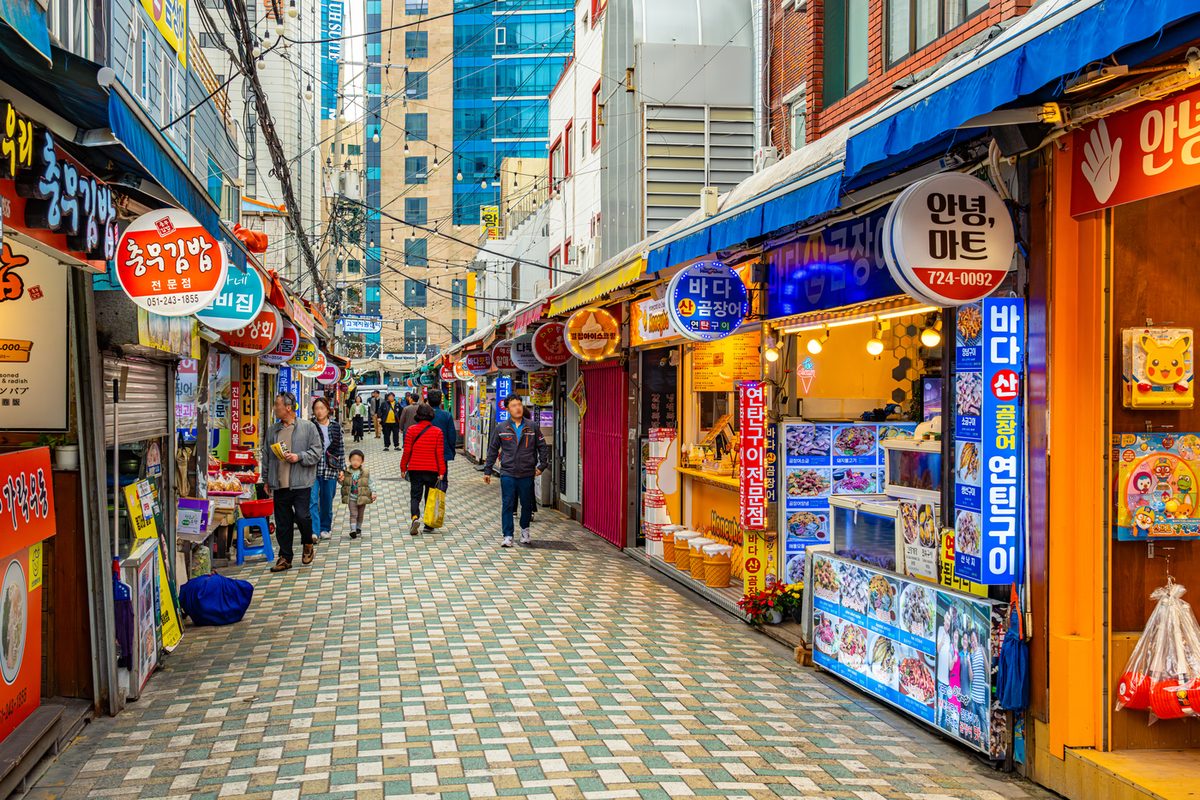
Haeundae Market has been going since the 1910s. According to the Korea Tourism Organization, people line up in front of shops known across the country for tteokbokki (spicy rice cakes), fried snacks, kalguksu (knife-cut noodles), kkwabaegi (twisted doughnuts) and dwaeji gukbap (pork and rice soup). Busan-style tteokbokki uses thick rice-cake sticks, and skewers of fish cake (eomuk) dipped in broth are also a feature of Busan snack shops. Hotteok (filled pancakes) have a Busan style too: ssiat-hotteok (씨앗호떡) is split open and packed with sunflower seeds, pumpkin seeds and peanuts.
The market alley is so full of the smell of grilled hagfish (gomjangeo, 곰장어) that it is also called the “gomjangeo alley.” Many shops also sell grilled hagfish and fresh raw fish sashimi (hwal-eohoe, 활어회). Visit Busan notes that vendors adding a little extra for free is part of the fun of the market. A day in Haeundae goes well in this order: start with snacks while looping the market, walk the beach, and finish the evening with grilled hagfish or raw fish.
If you want a hearty meal right next to the beach, see 20 Dwaeji Gukbap Spots, Picked by Busan Locals.
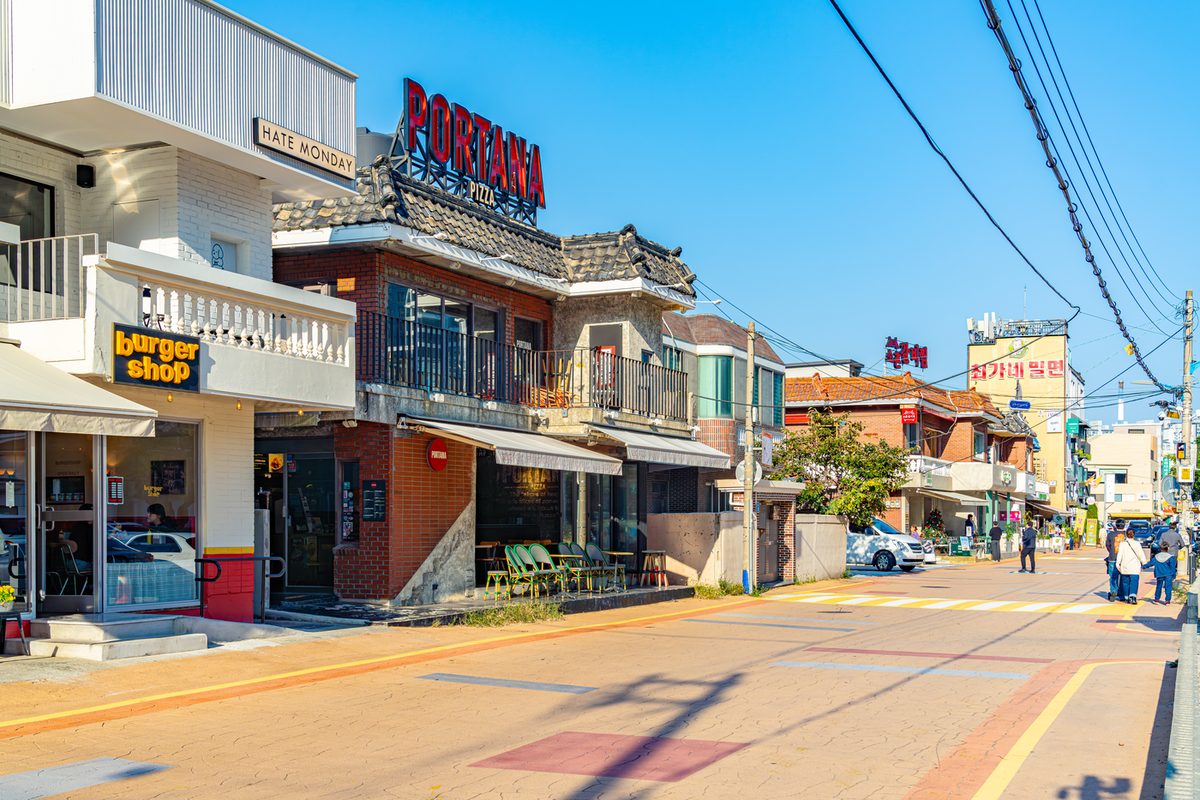
Haeridan-gil is tied to the Donghae Nambu Line story coming up. It is a neighborhood behind the old Haeundae Station, and it began when old houses were renovated into cafés and restaurants after trains stopped running. You will find dim sum, curry, brunch and Japanese-style desserts, and the low 2–3 story houses create a mood completely different from the tall buildings by the beach.
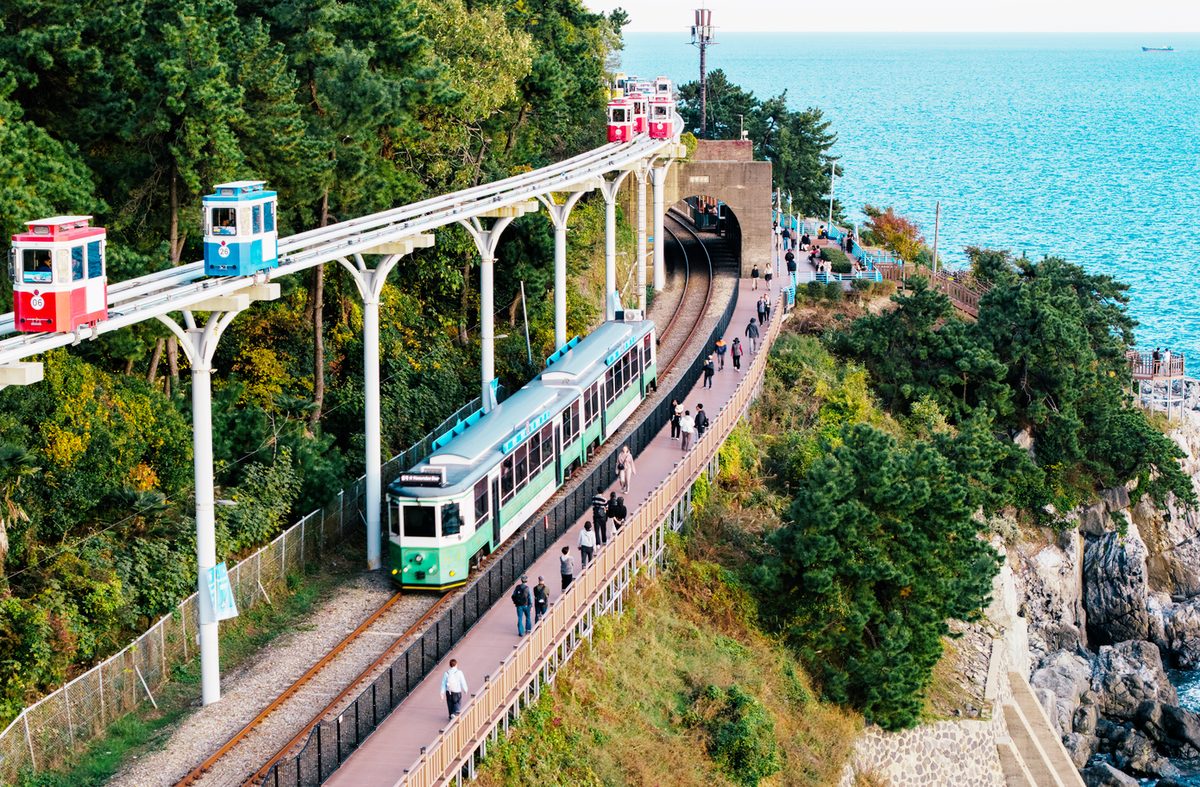
Blue Line Park (해운대 블루라인파크) is a tourist attraction built on the old coastal rail line of the Donghae Nambu Line (동해남부선). This line is an east-coast railway running from Busanjin through Ulsan to Pohang, and the stretch from Haeundae to Songjeong ran right beside the waves, which made it loved as a “sea train.” In December 2013 a new double-track electrified line moved inland and this coastal track was closed. After long discussion, most of it was left as a walking path, and the Mipo–Songjeong stretch was set aside for tourism development. That is how Blue Line Park, with its Beach Train and Sky Capsule, opened in October 2020. A walking path also runs beside the rails. Haeridan-gil, behind the old Haeundae Station, also appeared after the line closed.
There are two ways to ride, so decide first what to ride, where to get off, and how to come back to avoid confusion.
| Beach Train (해변열차) | Sky Capsule (스카이캡슐) | |
|---|---|---|
| Route | Mipo to Songjeong, 4.8 km | Mipo to Cheongsapo, about 2 km, one section per ride |
| Time | About 25 min one way | About 30 min one way |
| Seating | Open seating; everyone gets off at the end station | Up to 4 people per capsule |
| Height | On the rails | Elevated rail 7–10 m above the coast |
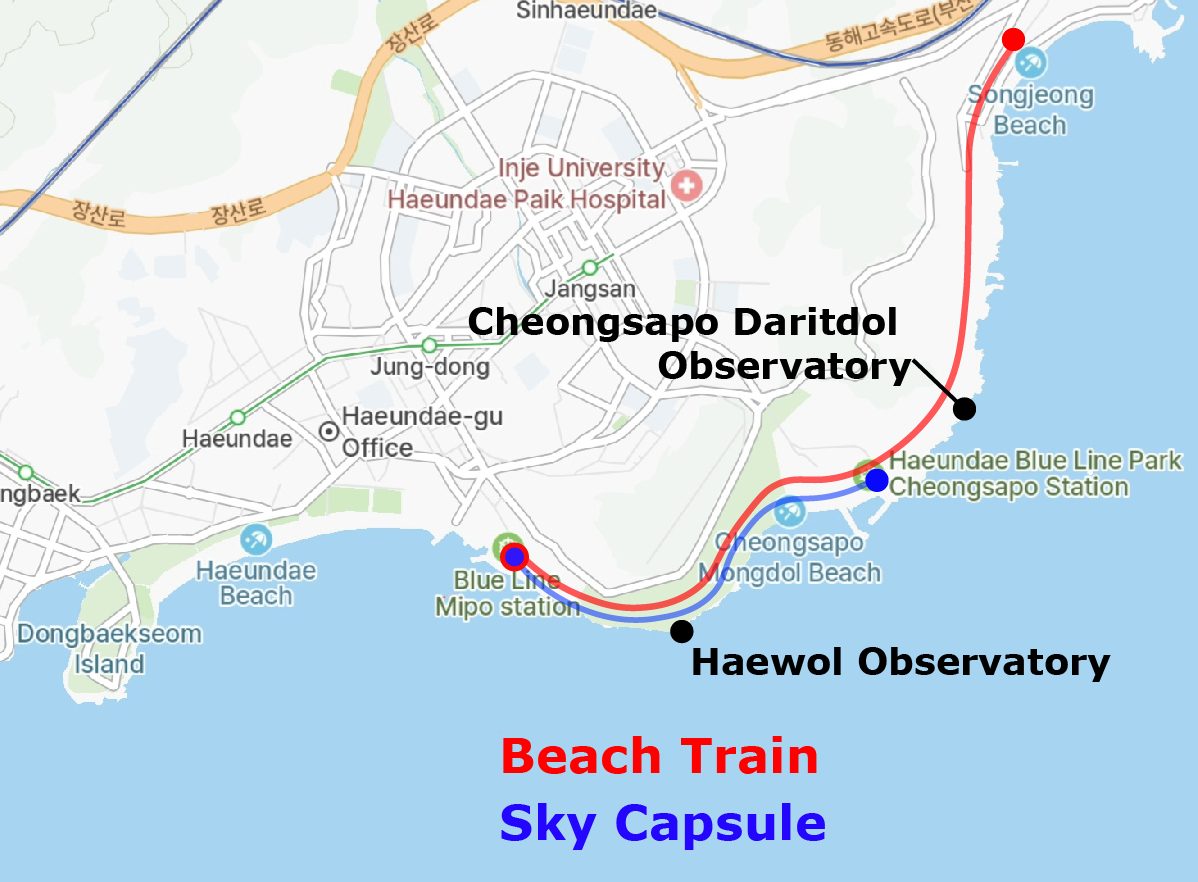
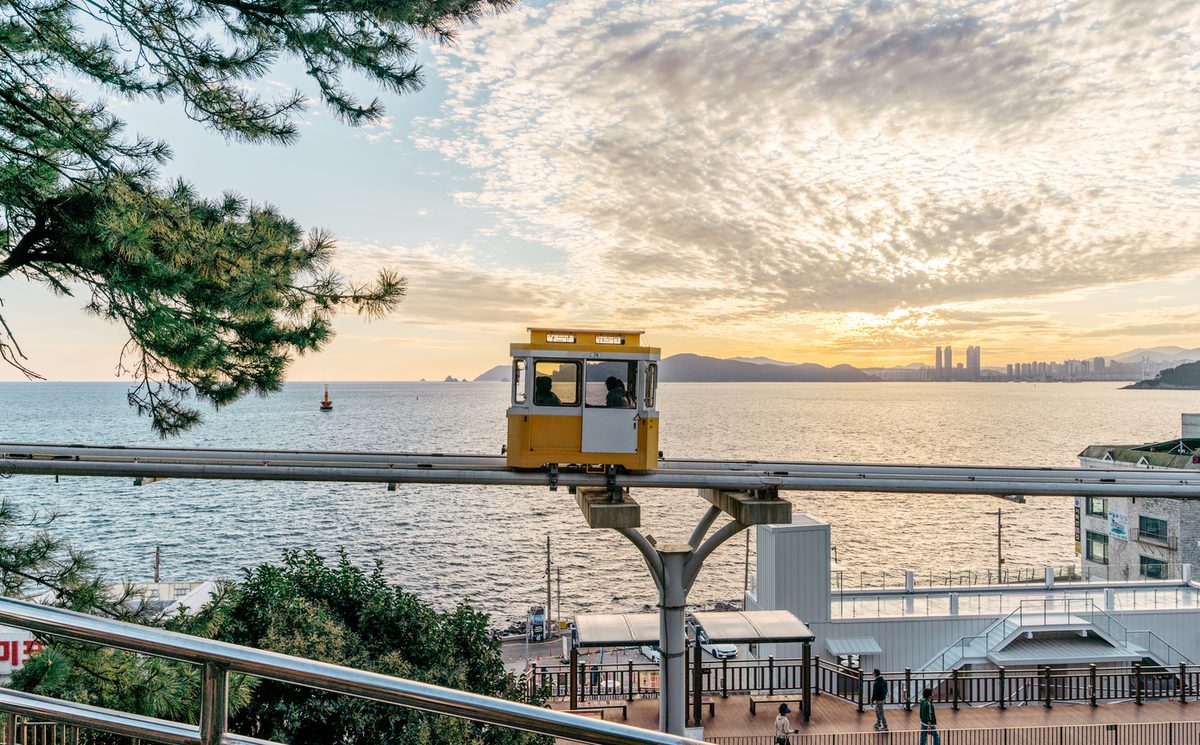
The Sky Capsule only runs about 2 km, from Mipo to Cheongsapo, along the shore below Dalmaji-gil. It glides slowly along an elevated rail beside the track that juts out over the sea, at 4 km/h, about walking speed. The Beach Train follows the same path past Cheongsapo all the way to Songjeong. It stops at Mipo, Dalmaji Tunnel, Haewol Observatory, Cheongsapo, Daritdol Observatory, Gudeokpo and Songjeong, in that order.
The Sky Capsule fare is “one way” (pyeondo, 편도). That means the price covers one ride to the station at the other end. The capsule can leave from either of the two stations, Mipo or Cheongsapo, so you can ride from Mipo to Cheongsapo or from Cheongsapo to Mipo. But after you get off at Cheongsapo, you cannot ride back on the same ticket. To return, you must buy a new capsule ticket that departs from Cheongsapo, and pay the fare again.
| Where the Sky Capsule starts | Location |
|---|---|
| ① Mipo Station | 13 Dalmaji-gil 62beon-gil, Haeundae-gu |
| ② Cheongsapo Station | 116 Cheongsapo-ro, Haeundae-gu |
Fares differ as follows. They follow the official fare page as of October 15, 2026; the amount shown on the booking screen is final.
| Beach Train (per person) | How many rides | Fare |
|---|---|---|
| Single-ride pass | One ride; you cannot re-board after getting off (one way) | From Mipo or Songjeong: 10,000 won From Cheongsapo or a small station: 8,000 won |
| Two-ride pass | One ride at each of two stations you choose (round trip possible) | 14,000 won |
| All-stations pass | One ride at every station, up to 7 rides | 16,000 won |
| Sky Capsule (per capsule, one way) | Fare |
|---|---|
| 2-seater | 50,000 won (25,000 won per person) |
| 3-seater | 55,000 won (about 18,300 won per person) |
| 4-seater | 60,000 won (15,000 won per person) |
The difference between the single-ride and two-ride pass is whether you can board again after getting off. A single-ride pass ends when you get off, so two single-ride passes for a round trip cost 20,000 won. A two-ride pass costs 14,000 won and covers a round trip, which is cheaper. You must get off at the end stations (Mipo and Songjeong), and that counts as one of your rides. If you want to get off at a middle station such as Haewol Observatory or Daritdol Observatory, look around and board again, pay 2,000 won more for the all-stations pass (16,000 won). A single-ride pass boarding at Cheongsapo or a small station costs less, at 8,000 won.
The Sky Capsule fare is for the whole capsule, so the more people share it, the lower the price per person. The capsules are all the same size, so just choose the 2-, 3- or 4-seater that fits your group.
Because there is no round-trip ticket for the capsule, a common combination is capsule on the way out, Beach Train on the way back. The operator also sells a “Sky Capsule (one way) + Beach Train (all stations)” package: 73,000 won for 2 people, 92,000 won for 3 and 111,000 won for 4. Buying separately for 2 people costs 82,000 won (capsule 50,000 won + all-stations pass 16,000 won × 2), so the package is about 9,000 won cheaper.
Which ticket should you buy? Here is a summary by route.
| If you travel like this | Ticket to buy |
|---|---|
| A. Capsule out, train back | Capsule + single-ride train pass |
| B. Train out, capsule back | Two-ride train pass + capsule |
| C. Capsule, then train to Songjeong | Capsule + two-ride train pass |
| D. Train round trip only | Two-ride train pass |
| E. Train one way only | Single-ride train pass |
| F. Get off midway to look around | All-stations pass |
A goes from Mipo to Cheongsapo by capsule, then returns from Cheongsapo to Mipo by train. You ride the train only once, from Cheongsapo, so the single-ride pass from Cheongsapo (8,000 won) is enough.
B goes from Mipo to Songjeong by train, gets off at Cheongsapo on the way back, and rides the capsule from there to Mipo. You ride the train once at Mipo and once at Songjeong, so you buy the two-ride pass (14,000 won) and reserve a separate capsule leaving from Cheongsapo.
C goes from Mipo to Cheongsapo by capsule, then by train from Cheongsapo to Songjeong, and by train from Songjeong back to Mipo. You ride the train once at Cheongsapo and once at Songjeong, so the two-ride pass (14,000 won) is enough.
Operating hours change with the season. The last ride times are below.
| Season | Beach Train | Sky Capsule |
|---|---|---|
| Nov–Feb | 09:00–19:00 | 08:30–18:00 |
| Mar, Apr, Oct | 09:00–19:30 | 08:30–18:30 |
| May, Jun, Sep | 09:00–20:30 | 08:30–19:30 |
| Jul, Aug | 09:00–21:30 | 08:30–20:30 |
Hours may be adjusted on weekends, public holidays and for safety checks. It runs normally in the rain and stops in disasters such as typhoons.
| Question | Good to know |
|---|---|
| When do tickets open? | Online tickets for one week (Monday–Sunday), four weeks ahead, open every Tuesday at 7 a.m. There is an official English booking page |
| Can I buy on site? | A few tickets are sold on site, first come first served, and they can sell out early. Same-day online booking closes 2–3 hours before use |
| How do I get the ticket? | The QR code on the ticket is your boarding pass. Mobile tickets arrive by KakaoTalk or email, so enter your email address correctly |
| What is the Sky Capsule booking time? | It is not a departure time but a 30-minute window in which you can enter. For example, with an 11:00–11:30 ticket you enter within that window and board in order |
| What if I am late? | If you are more than 30 minutes late for your booked time, boarding may be refused with no refund. For the Beach Train, the waiting line closes 10 minutes before departure |
| What about cancelling? | Full refund up to 3 days before, 20% deducted 2 days before, 30% deducted 1 day before, 50% deducted on the day of travel, before departure |
| What about big bags? | There are lockers at Mipo, Cheongsapo and Songjeong stations (small 2,000 won, medium 3,000 won, large 5,000 won) |
Sky Capsule and Beach Train tickets can also be booked on the travel booking platform KKday. Check the contents, price and how to use the ticket on the booking screen.
The Sky Capsule fare is one way. If you board at Mipo, you get off at Cheongsapo. You cannot come back on the same ticket. The capsule leaves from either Mipo or Cheongsapo, so to return, buy a new capsule ticket from Cheongsapo or take the Beach Train.
If you book the capsule and the train together, keep to the order. If you ride the capsule first, book the train at least 1 hour later; if you ride the train first, book the capsule at least 30 minutes later, so the timing works. If you start from Songjeong, ride the train first, because the capsule only leaves from Mipo and Cheongsapo.
Dalmaji-gil (달맞이길) is a hill road of about 8 km linking Haeundae and Songjeong. Cherry and pine trees line it, and from Haewoljeong (해월정) at the top you can look down on Cheongsapo and the sea. It is famous for its beautiful moonrise.
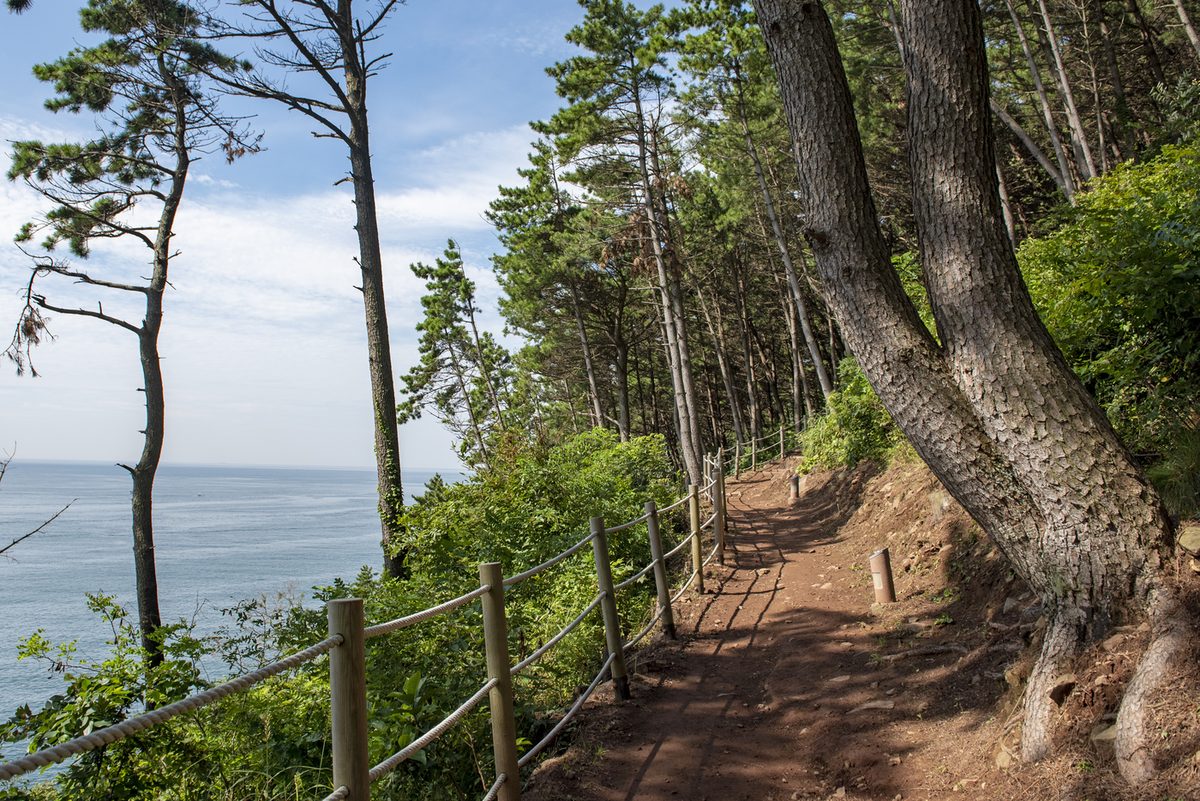
In the woods below the road is Moontan Road (문탠로드). This 2.2 km forest path runs between the Dalmaji-gil road and the old rail line, and a full loop takes about an hour. It is free, and its lights are on from sunset until 11 p.m. and from 5 a.m. until sunrise. If you do not return to the start and keep following the old rail line, you reach Cheongsapo.
| Place | How to get there |
|---|---|
| Haewoljeong (해월정) | Leave Haeundae Station Exit 1 and turn right, then take village bus Haeundae-gu 2 (해운대구2번) or Haeundae-gu 10 (해운대구10번) and get off at the Haewoljeong-ipgu (해월정입구) stop. About 7 minutes on foot Naver Map |
| Moontan Road (문탠로드) | From Jangsan Station (장산역) Exit 5 or Exit 7, go straight about 700 m. It starts at the five-way intersection you reach Naver Map |
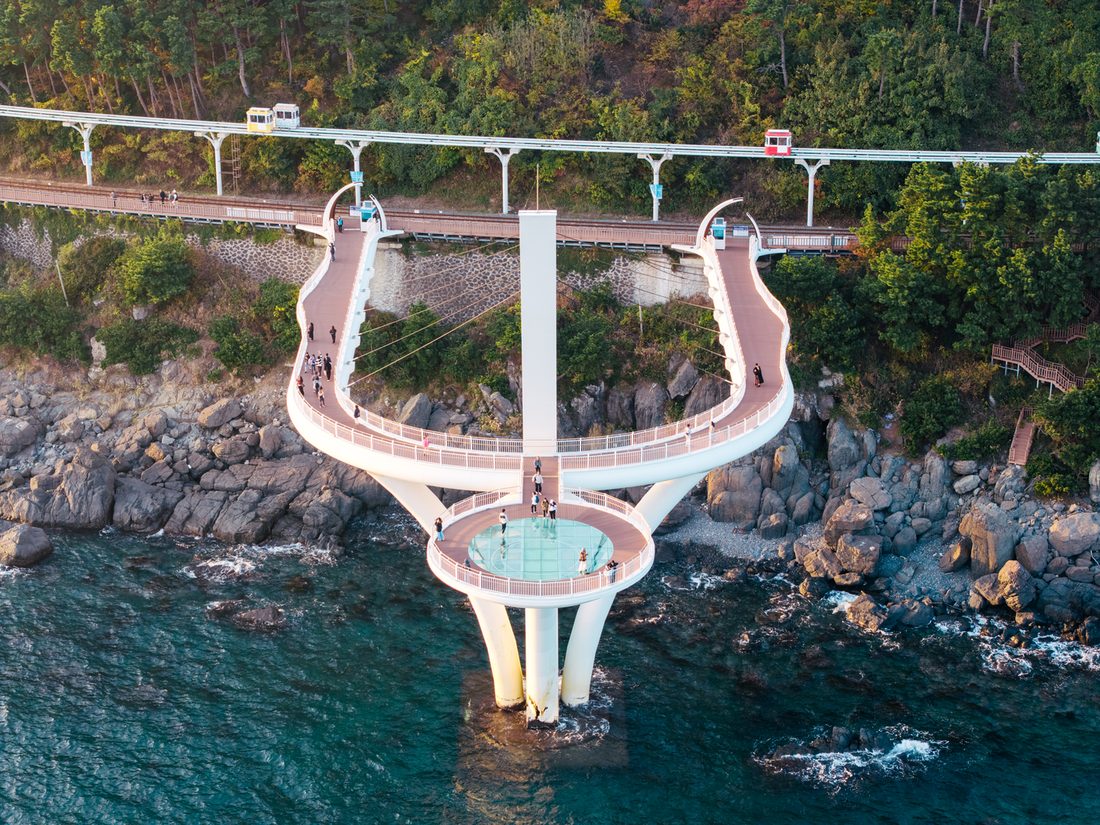
Haewol Observatory (해월전망대) opened in 2024 beside the rail line on the shore below Dalmaji-gil. Haewol means “enjoying the scenery while meeting both the sun and the moon.” Because Dalmaji-gil sits where the East Sea meets the South Sea, you can see both sunrise and moonrise from one spot, and it is counted as one of the “Eight Scenic Views of Korea (대한8경).” The name carries that story.
| Item | Details |
|---|---|
| Shape | A U-shaped skywalk reaching out to sea. 137 m long, about 22 m above sea level |
| What stands out | A crescent-shaped main tower and a round plaza 15 m across. The plaza floor has LED glass that glows at night |
| Underfoot | You can see the waves through the tempered-glass floor |
| What you can see | Haeundae Beach and the Gwangan Bridge in one view, and in the distance Cheongsapo Daritdol Observatory |
| How to get there | Get off the Beach Train at Haewol Observatory station, or walk the path beside the rails from Mipo, about 1.2 km. You can also walk down the path from Dalmaji-gil. There is no parking lot of its own |
It is cooler and the view is better early in the morning or around sunset than in the strong midday sun. Opening hours change by season, so check before you go.
Location — Haewol Observatory: San 42-64, Jungdong, Haeundae-gu
Cheongsapo (청사포) has a fishing harbor, lighthouses and seaside cafés, and Blue Line Park’s Cheongsapo Station. Next to the station, Daritdol Observatory (다릿돌전망대) is an observation deck that reaches out over the sea. It is a good place to be around sunset.
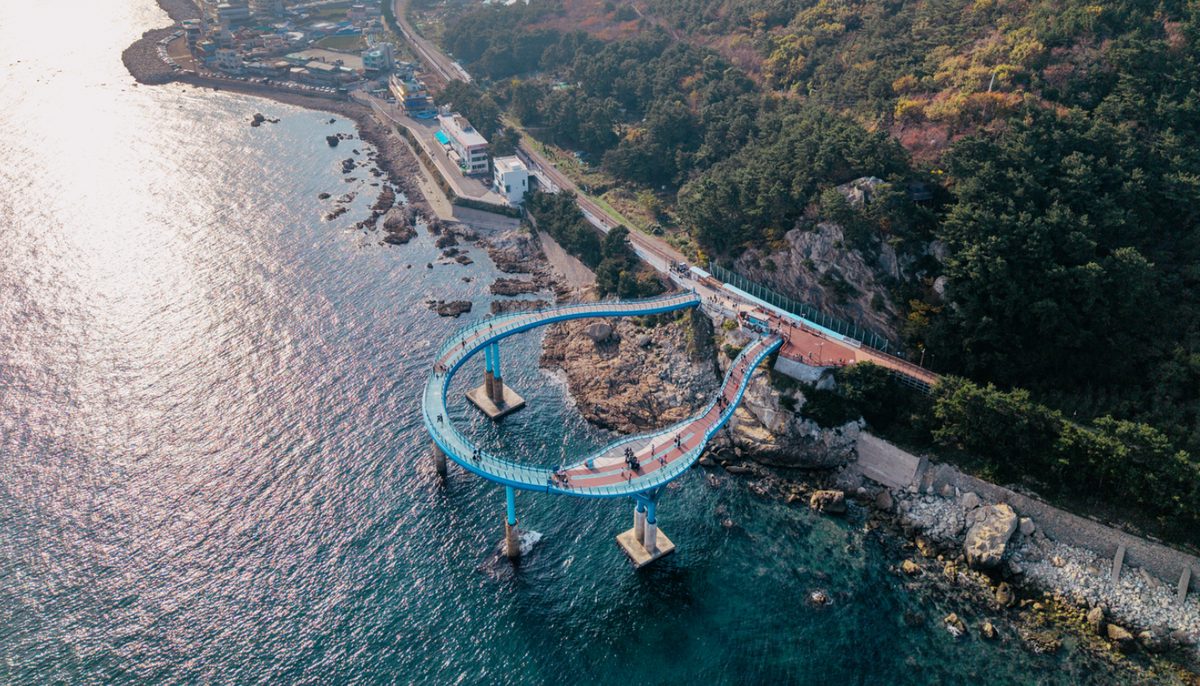
Location — Around Cheongsapo-ro, Haeundae-gu
Location — Cheongsapo Daritdol Observatory
| Time | What to do |
|---|---|
| 9 a.m. | Dongbaek Island, timed to Nurimaru’s opening (closed the first Monday) |
| Midday | Walk east along the beach, lunch |
| Afternoon | Blue Line Park from Mipo (keep to your booked time) |
| Before sunset | Cheongsapo and Daritdol Observatory (check the last ride time) |
| Coming back | Beach Train or village bus back toward Haeundae (the capsule needs a new ticket on the way back) |
This is not a fixed course. Blue Line Park runs in the rain, but Moontan Road, a forest path, can be slippery, so decide according to the weather.
If you want to see the night view with a guide in the evening, there is also a Busan night tour that includes a Sky Capsule ride. You choose between a Marine City night-view course and a night-view course on the Jagalchi side. Check the course details, departure time and price on the booking screen.