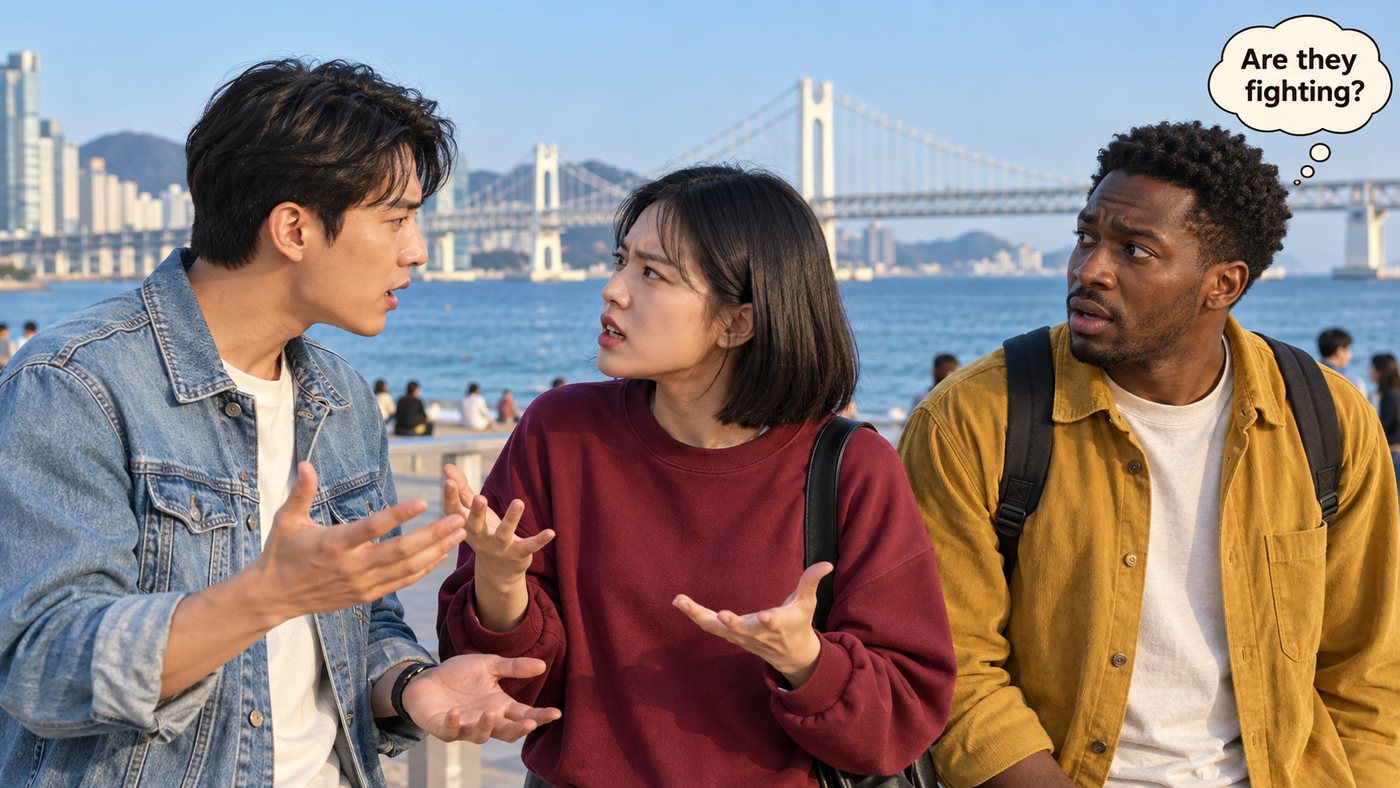
With loud voices and strong intonation, it can sound like an argument, but it's really just how people normally talk. Here are 12 questions foreigners often ask in Busan about the people and the dialect (satoori).
As of October 2026 — people differ, so please read each point as "this is often the case."
When you live in Busan, you may sometimes wonder, "Why do people here talk so loudly and quickly?" This guide picks 12 questions foreigners often ask in Busan and explains why it happens and how to take it in stride. Not every Busan person is the same. Please read the explanations below as "this is often how it feels."
| Situation | Common reason | Try this |
|---|---|---|
| It sounds like they're fighting | Strong intonation and a loud voice | Look at the facial expression and mood too |
| The dialect sounds rough | It depends on the speaker's attitude | See whether they're smiling as they talk |
| I don't understand some words | Busan has its own words and endings | Learn a few common ones |
| I'm worried about the dialect | Wording is mostly standard Korean, but the intonation remains | "Please speak a little slower" |
| I want to try using the dialect | Friends usually react well | Don't use "ma" or "imma" with older people |
| I can't tell if people are friendly | Curt, but there's jeong (warmth) underneath, and the setting differs from Seoul | Remember that it depends on the person |
| I heard "Uri-ga nami-ga?" | Once you get close, they treat you like family | Give it time to get close |
| Market vendors are curt | It's just their way of talking, not unkindness | Look at their expression and mood, not the tone |
| The baseball stadium is so intense | It carries the pride of Busan people | Go and see it for yourself |
| There's so much dwaeji-gukbap and milmyeon | They began in the Korean War refugee years | Try adding chives (jeonggu-ji) |
| I'm worried about making friends | It depends more on the individual and situation than the region | Find a regular meetup |
| Daily life is inconvenient | Hills, buses, late-night transport, humidity | Plan your routes and transport ahead of time |
The Busan dialect has strong intonation and a loud voice, and sentences often go down at the end instead of rising. So even questions can sound like statements, and a conversation can sound like an argument. Even Koreans from Seoul sometimes feel the same way.
But in most cases they're not angry. It's just how they normally talk. People tend to say things straight out without dressing them up, so it can sound rough, and you'll often hear that they are warm underneath.
These days, many people in their 20s and 30s or younger swap the dialect wording for standard Korean, but in many cases the intonation stays exactly as the dialect, so you may get the same impression.
Look at the facial expression and mood, not just the tone. If they're smiling or speaking to help you, it's usually just their normal way of talking.
The same words sound different depending on who says them and with what attitude. When a warm person speaks in dialect, it sounds warm and friendly, and when an unfriendly person does, it sounds much rougher. Foreigners learning Korean often find it cute mainly because they hear it in friendly situations.
So there's no need to conclude that the dialect itself is rough. It's better to look at the speaker and the situation together.
These are expressions foreigners actually hear a lot in Busan. The meanings are written in casual speech.
| Phrase | Meaning | Good to know |
|---|---|---|
| 밥 먹었나? (밥 뭇나?) bap meogeonna? (bap munna?) | Did you eat? | "Bap meogeonna?" is used more. It's also used as a greeting to ask how you're doing |
| 뭐라노 (뭐라카노) mworano (mworakano) | What are you saying? / What did you say? | "Mworano" is used more. Playful between friends, sharp when arguing |
| 와? / 와 그라노 wa? / wa geurano | Why? / Why are you like that? | "Wa" means "why" |
| 마 / 임마 ma / imma | Hey, you | "Imma" is also common. Only use it between close friends |
| 맞나? manna? | Is that so? / Really? | It's a way of reacting to what someone says |
| ~하이소, ~사이소 -haiso, -saiso | Please do ~, please buy ~ | Older people use these a lot |
| 합니까? / 갑니까? hamnikka? / gamnikka? | Do you do ~? / Are you going? | A polite way of asking |
| 정구지 jeonggu-ji | Chives (buchu) | People add it to dwaeji-gukbap |
Adding ~나 (-na) to the end of a verb makes it a question, as in "밥 먹었나? (bap meogeonna?)" or "가나? (gana?)". For questions that include a question word like "what" or "where," people sometimes use ~노 (-no) instead, as in "뭐 하노? (mwo hano?)".
~아이가 (-aiga) is used in two ways. After a noun, it is more often a question meaning "isn't it ~?". After a verb, it means "~, you know" or "~, didn't I?" (like Korean ~잖아). "내가 그리 말했다이가 (naega geuri malhaetdaiga)" means "I said it like that, didn't I?", and "내가 내일 간댔다이가 (naega naeil gandaetdaiga)" means "I told you I'm going tomorrow."
You don't need to worry much. These days, people in their 20s and 30s or younger use these dialect expressions less. They often use standard-Korean wording. For example, they say "밥 먹었어? (bap meogeosseo?)" more often than "밥 먹었나? (bap meogeonna?)".
However, the intonation stays as the dialect. Seoul speech raises the end of a question, but in Busan, even when the wording is the same as Seoul's, people often lower the end. So you may recognize the words but find the way of speaking unfamiliar.
If you couldn't follow a lecture or conversation because of the dialect, that's nothing strange. Even Koreans from different regions sometimes don't understand each other's words.
If you didn't catch something, say "조금만 천천히 말씀해 주세요 (jogeumman cheoncheonhi malsseumhae juseyo)," meaning "Please speak a little slower." Most people will slow down and put it more simply.
It's not strange. When a foreigner uses the dialect with close friends, most people find it fun and are glad to hear it. You can try expressions like "밥 먹었나? (bap meogeonna?)" and "맞나? (manna?)" without worry.
However, words with a strong casual-speech (banmal) feel, like "마 (ma)" and "임마 (imma)", sound rude if you use them with older people or someone you've just met.
At first, focus on understanding, and start using it only with people you've become close to, when the mood is playful.
Opinions differ from person to person on this. Some people say Busan is more relaxed and friendly than Seoul, and others say Seoul is more comfortable. It's hard to say either side is right.
There is one explanation you hear often, though: on the surface they're curt and direct, but they're warm inside. The speech may sound rough, but once you get close, they often look after you first, people say.
What's interesting is that many Busan people say that when they start school or work in Seoul, they feel "Seoul has no jeong (정, warmth/affection), draws sharp lines, and is stiff and by-the-book with people." This is a side that comes out of a competitive environment. Seoul is where people from all over the country gather, so competition is bound to be fiercer, and this comes from trying to survive in that setting. So it's better to see it as a difference between the provinces and Seoul rather than between Busan and Seoul.
On the other hand, people who have lived in Seoul for a long time and then go to the provinces first notice the generous hospitality. For example, restaurants give you extra side dishes, and you feel the portions are different from Seoul.
It means "Are we strangers?" In other words, it expresses the feeling of "we're on the same side." People treat someone they're close to like family, while to someone they aren't close to yet, the way of speaking can sound strong.
It connects to the jeong (정, warmth and attachment) and the spirit of sticking together explained in K-Rambles' Why Do Koreans Ask Your Age First? 12 Everyday Korea Questions Foreigners Ask Most guide. At first there's some distance, but once they open up, they look after you deeply.
Even if people feel cold at first, try not to feel hurt. If you keep going to the same shop or the same group, in many cases you'll get close at some point.
Vendors at markets like Jagalchi Market (자갈치시장) and Gukje Market (국제시장) have loud voices and short sentences. Rather than being unfriendly, in many cases that's simply how they talk. Since many tourists take photos and leave, they may also keep it even shorter.
Look at their expression and mood, not just the tone. Even when the words are short, they often show jeong (정, warmth) by adding a little extra to your purchase.
The cheering at Sajik Baseball Stadium (사직야구장) for Busan's pro baseball team, the Lotte Giants (롯데 자이언츠), is famous. Everyone sings the cheer songs together, and the fans cheering as one is tied to the pride of Busan people.
Besides watching baseball, many people go because they enjoy the cheering atmosphere with friends. You can enjoy it for the atmosphere alone even if you don't know much about baseball, so one visit lets you feel Busan people's cheering culture right away.
Both dishes began in the days when refugees gathered here during the Korean War. People made broth from pork bones and noodles from wheat flour, and got through hard times on them.
For dwaeji-gukbap (돼지국밥, pork and rice soup), people season it to their own taste by adding jeonggu-ji (정구지, chives), salted shrimp (saeu-jeot), and chili.
You can read more about this history in K-Rambles' 돼지국밥: the soup a war left behind and Milmyeon: a different story from naengmyeon.
Some people compare, saying Busan is easier or Seoul is easier, but it's better to say there is practically no difference. Making friends depends on very personal things and on each person's situation. Korea isn't a large country, so it's also hard to say that national character differs from region to region.
Wherever you live, it's much easier if you have a group you meet with regularly. Korean classes, exercise groups, and language-exchange meetups are typical examples. Koreans often find neighborhood groups through apps like Somoim (소모임) and Daangn Market (당근마켓, also known as Karrot).
The many hills and the sharply curving bus routes in Busan come from Busan's terrain. Busan has many mountains, so the city grew along the valleys between them. But with so many people, houses climb up to the middle of the mountainsides in many places. Because it's hard to build straight roads among the mountains, the roads are steep and winding.
When looking for a home, be sure to check the hills on the map. For how to find a home, see also Finding Long-Stay Housing in Korea as a Foreigner.
| Topic | One thing to remember |
|---|---|
| Way of speaking | Loud and strong doesn't mean angry, it's their normal way of talking |
| Dialect | Rather than worrying, just learn a few common expressions |
| People | Curt at first, but once you get close they treat you like family |
| Daily life | Check the hills, buses and late-night transport ahead of time |
This guide sums up general tendencies, so it can differ by person, region and generation. If you're curious about life in Korea more broadly, read Why Do Koreans Ask Your Age First? 12 Everyday Korea Questions Foreigners Ask Most and Do You Have to Go to Hoesik? 12 Korean Workplace & Campus Questions Foreigners Ask Most too.