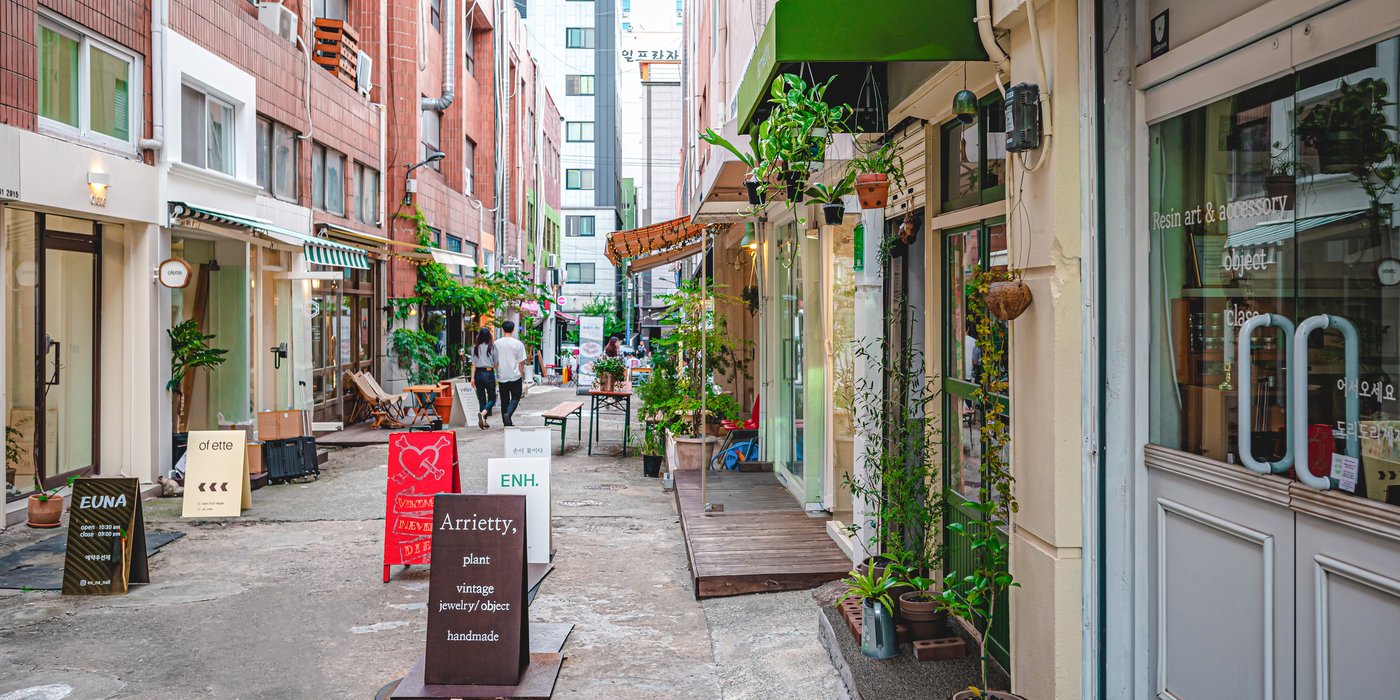
Walk into a Korean cafe and you will see people drinking iced drinks in midwinter and photographing their food before the first bite. This guide introduces Korean cafe culture and how to enjoy it in Busan.
As of October 2026 — every cafe does things a little differently. Check the signs at the entrance and on the tables first.
Depending on the neighborhood, you can walk a few steps in Korea and find a cafe next to a cafe, with yet another on the floor above. With so many shops, it is hard to stand out on coffee quality alone.
So cafes compete on other things: seasonal menus that change with each season, desserts that photograph well, hanok (한옥, traditional house) or sea-view spaces, and concepts like cats or board games. People in the industry say that this competition has raised both the skill of making coffee and the eye for designing spaces.
As cafes became this easy to reach, people started doing more than drinking coffee there: studying, working, holding meetings, and meeting friends. A cafe became a place to spend time that is not home, the office, or school.
Conflict followed. People who sit for hours on a single drink while studying, called "카공족" (kagongjok), were criticized as a nuisance to other customers and to the shop. In response, some cafes put up "1인 1음료" (il-in il-eumnyo, one drink per person) notices, or cut the number of power outlets so people could not use laptops for long. More recently, some cafes have gone the other way, adding an outlet at every single-seat table to welcome kagongjok. Customers and cafes have bumped into each other and adjusted, and that is how today's cafe culture took shape.
The winter iced Americano, photo-taking habits, and many kinds of cafes in this guide all come out of that atmosphere.
"얼죽아" (eoljuga) is short for "얼어 죽어도 아이스 아메리카노," meaning "iced Americano even if I freeze to death." It describes people who insist on an iced Americano even on snowy days, or that preference itself. An iced Americano (아이스 아메리카노, aiseu amerikano) is shortened to "아아" (a-a), and a hot Americano (뜨거운 아메리카노, tteugeoun amerikano) to "뜨아" (tteu-a).
Korean winters are quite cold. Seoul is usually below freezing in winter, and cold days drop to -10°C. Busan is usually around 0°C, and cold days can drop to about -5°C. Busan is also on the coast and windy, so it feels colder than the thermometer says.
Even so, many people in Korea drink iced Americanos in winter. It is easy to see people walking down a freezing street with an iced Americano in hand. A 2023 foreign news report even featured an office worker drinking an iced Americano during a -17°C cold snap.
The numbers back this up. Industry data shows that even in winter (December to February), iced drinks make up about 45–65% of sales at major coffee brands. In one brand's survey, iced drinks made up 64% of winter drinks among people in their twenties, and 82% over the whole year.
One reason is that in Korea, people drink cold water at home all year round, whatever the season. So an iced Americano in winter does not feel strange. Homes are well heated in winter, so cold water is fine indoors, and cafes and offices are warm in the same way, so a cold drink feels refreshing. A clear cup also shows its layers nicely in photos. Not everyone does this, though. At neighborhood cafes, many older customers drink hot drinks.
Trends play a part too. Koreans tend to react quickly to trends. Once the word "eoljuga" spread, the word itself became a trend, and people order an a-a because others are drinking it, which keeps repeating. The word creates the habit, and the habit spreads the word again.
Ordering the same menu item works the same way. When a group goes to a cafe, it is common to order the same item for everyone. If someone says "아아 네 잔" (a-a ne jan, four iced Americanos), everyone orders an a-a. Part of the reason is the belief that if everyone orders the same thing, it can be made in one batch and comes out faster.
Restaurants are similar. Groups often order the same dish because they think if everyone orders the same menu item, the kitchen cooks it all at once and it comes out faster.
Behind this is "빨리빨리" (ppalli-ppalli) culture. "Ppalli-ppalli" means "hurry, hurry," a phrase used all the time in Korea for a general feeling that getting things done fast matters. An analysis that says iced drinks are popular with office workers on short lunch breaks because they can be finished quickly points in the same direction.
Studying or working in cafes is common in other countries too, but in Korea so many students and office workers do it that there is a word for it. "카공족" (kagongjok) means "people who study at cafes," and it is also used broadly for people who work on laptops. In a 2025 survey of 2,037 Gen Z job seekers, 70% said they study at cafes at least once a week. The top reason, at 58%, was "I can concentrate better."
In the same survey, the most acceptable time to sit with one drink was 2–3 hours (42%), followed by 3–4 hours (23%). The behaviors people called the worst manners were saving a seat and leaving for a long time (29%) and talking loudly on the phone or in conversation (25%). For this reason, some cafes post a notice asking for "1인 1음료" (il-in il-eumnyo), meaning one drink per person using a seat.
Laptops are fine, but if you plan to work for a long time, check whether there are power outlets. The Wi-Fi password is more often posted on a wall than printed on the menu. Some cafes have reduced outlets or blocked power strips to discourage long laptop sessions. Starbucks also restricted personal desktop computers, printers, partitions, and power strips from August 2025.
These days, a growing number of independent cafes do the opposite: they put an outlet at every single-seat table and post a note asking you to "please keep your computer use reasonable," to welcome kagongjok. In exchange, these cafes tend to charge more for coffee. Since people occupy a table for a long time, the cafe and its customers have found a compromise.
In Korean cafes, it is common to leave a bag, laptop, or phone at your seat while you go order or use the restroom. This is also a scene often introduced as something that surprises foreigners.
Reasons often given include a social understanding that you do not touch other people's belongings, CCTV everywhere, and less pickpocketing-type petty theft as people carry less cash. Lost items often come back too. Seoul's subway received about 100,000 lost items in 2021 alone, and 65% went back to their owners within a week. Wallets were the most common item (24%).
That does not mean there is no theft. More than 180,000 theft cases were reported to police in 2020. So when Koreans leave things behind, it is a habit built on trust within the country, not a guarantee that it is safe for everyone. If you are traveling, it is safer to take valuables such as your passport, wallet, phone, and laptop with you.
When coffee, cake, or drinks arrive at a pretty cafe, taking photos before eating is very common. People take them to post on Instagram, and even when they do not post, they share them with friends in a chat app or keep them to look at later. The same goes for meals. There is even a word for it, "먹스타그램" (meokseutageuraem), a blend of "먹다" (meokda, to eat) and "인스타그램" (inseutageuraem, Instagram).
In 2017, the Korea Foodservice Industry Research Institute named "인스타그래머블" (inseutageuraemeobeul, "Instagrammable") as a key issue for the restaurant industry. It meant that how food is plated and how a shop looks had become a way to promote it. In a survey of Korean travelers (Hotels.com, reported in 2018), the top photo type posted on social media during a vacation was food and restaurants (64%).
So cafes make drinks and desserts that photograph well. Desserts shaped like rabbits or puppies out of whipped cream, "too cute to eat," have been a hit. There is no need to find it odd if your group takes photos as soon as the drinks arrive. It is a normal thing in Korea.
There is one more slightly unusual habit. When food or drinks arrive at a restaurant or cafe, people do not start eating right away but wait for everyone to finish taking photos. This is often seen among women in particular. They give their friends time to take photos, and start eating after checking that everyone is done. A question like "다 찍었어?" (da jjigeosseo?, "Are you done taking photos?") can serve as the signal to start eating.
Korean cafes come in a great variety. Some foreign visitors say they remember the concept more than the coffee.
| Type | What it is |
|---|---|
| Study cafe (스터디카페, seuteodi kape) | A quiet study space for people preparing for exams or certifications |
| Board game cafe (보드게임카페, bodeu geim kape) | A place to play board games with drinks |
| Animal cafe (동물카페, dongmul kape) | A place to spend time with cats or dogs |
| Book cafe (북카페, buk kape) | A place set up for reading, working, and relaxing |
| Hanok cafe (한옥카페, hanok kape) | A cafe in a converted hanok (traditional Korean house). Many are in neighborhoods like Ikseon-dong (익선동) in Seoul |
| Pop-up and character cafe (팝업·캐릭터 카페, pabeop, kaerikteo kape) | Limited-time cafes in partnership with idols, animation, games, or webtoons. The Korea Tourism Organization also presents them as content that draws younger tourists |
Menus at Korean cafes follow trends quickly, and new items arrive every season. These are the best-known items that cafes abroad now copy.
| Item | What it is |
|---|---|
| Salt bread (소금빵, sogeumppang) | A buttery roll baked with salt on top |
| Croffle (크로플, keuropeul) | A dessert made by pressing croissant dough in a waffle iron |
| Bingsu (빙수) | Finely shaved ice topped with fruit, red bean, rice cake, milk, and more. The chain Sulbing (설빙) has expanded to the US, Australia, Japan, Malaysia, and Cambodia |
| Yakgwa (약과) | A traditional Korean sweet made with honey and oil. It is now popular as a cafe dessert |
| Cream coffee (크림커피, keurim keopi) | A Korean take on Austria's Einspänner. Besides whipped cream, cafes top it with black sesame, mugwort (쑥, ssuk), chestnut, or almond cream |
| Dalgona coffee (달고나커피, dalgona keopi) | A whipped coffee that went viral in Korea in 2020, when people were staying home because of COVID-19, and then spread worldwide |
Jeonpo Cafe Street (전포카페거리, Jeonpo kape geori) is a street of cafes in Jeonpo-dong (전포동), Busanjin-gu (부산진구). The neighborhood used to be full of small factories and tool shops, and from around 2010, empty factories and old houses began turning into small cafes. Most are run by individual owners, so people looking for something different from the chains gather here.
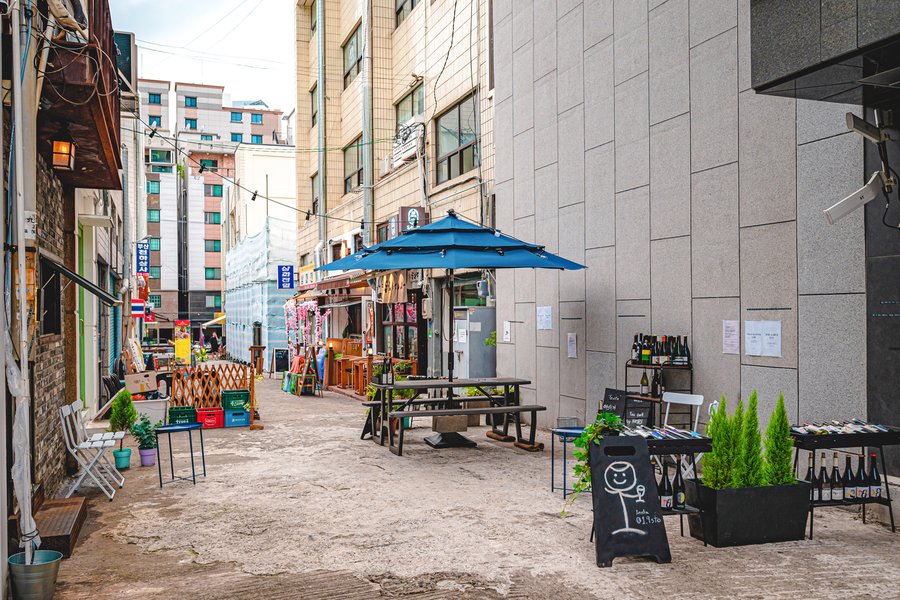
The closest comparison in Seoul is Mullae-dong (문래동). Mullae-dong also became popular as cafes and restaurants opened between old ironworking shops. If you are planning to visit Seoul next, or coming down from Seoul to Busan and heading back, it is fun to compare the two.
It is close to Seomyeon (서면), so you can walk. It is about a 10-minute walk from Exit 6 of Seomyeon Station (서면역) on Busan Subway Line 1. There are also cafes near Exit 7 of Jeonpo Station (전포역) (Line 2), and many across the road from it. It is worth exploring both sides. Closing days differ by shop, so check opening status in the Naver Map app before you go.
If you want a cafe with a sea view, Yeongdo (영도)'s Huinnyeoul Culture Village (흰여울문화마을) is another option, with cafes along the alley that have terraces facing the sea. For details, see Huinnyeoul Culture Village, the Alley Closest to the Sea.
Location — around Jeonpo-dong, Busanjin-gu
If you come from a country where staff bring drinks to your table, this may feel unfamiliar. At most Korean cafes, you order and pay at the counter, then pick up your drink yourself. At many places, staff will not come even if you sit and wait. The things that can make you pause are the three below.
| What you may wonder | Good to know |
|---|---|
| "드시고 가세요?" (deusigo gaseyo?) | Staff always ask this when you order. Since 2018, Korea has banned disposable plastic cups inside stores, so if you drink in, you get a mug or reusable cup, and if you take it away, a disposable cup. At a kiosk, you choose between "먹고 가기" (meokgo gagi, for here) and "가져가기" (gajyeogagi, to go) |
| I did not finish my drink and want to take it with me | You cannot take a mug out. Ask the staff "일회용컵에 담아 주세요" (ilhoeyongkeobe dama juseyo) and they will pour what is left into a disposable cup |
| The restroom door is locked | Many are shared building restrooms with a passcode. The code is printed on your receipt or posted near the counter. If you cannot find it, ask "화장실 어디예요?" (hwajangsil eodiyeyo?, Where is the restroom?) |
You return your empty cup yourself. At most cafes, put it where you picked up your drink (the pickup counter). Places like Starbucks and Coffee Bean have a separate return station, and the bins may be split into "일반쓰레기" (ilban sseuregi, general waste), "재활용" (jaehwaryong, recycling), and "얼음" (eoreum, ice). Pour out leftover ice and drink into "얼음," put things that can be recycled, like plastic cups, in "재활용," and things that cannot be recycled in "일반쓰레기." Many places have no signs explaining this, so remember these Korean words and sort by reading the labels.
You do not need to tip. Tipping and self-service at restaurants are also covered in Busan Restaurant Guide for Foreigners: 12 Most-Asked Questions — Eating Alone, Self-Service, Paying and Tipping.