If you've walked into a Korean restaurant not knowing where to sit, where to get water, or when to pay, this guide is for you. It covers the 12 questions foreigners ask most about eating out in Busan.
As of October 2026 — every restaurant does things a little differently. Check the signs at the entrance and on the table first.
Korean restaurants differ from those back home in a few ways. The questions people ask most are whether you can eat alone, how you get water and side dishes, how you call staff, and where you pay. Here are the 12 questions foreigners ask most in Busan, in order.
| Question | Short answer | Details |
|---|---|---|
| Can I eat alone? | Quiet places are fine. Some busy places turn away solo diners at mealtimes | 1–3 |
| Water and banchan? | If it says "셀프" (selpeu), help yourself. If not, ask staff | 4 |
| How do I call staff? | Press the call bell on the table | 5 |
| Ordering and paying? | Pay at the counter on your way out, or pay up front when you order | 6–7 |
| Tipping? | Not needed | 8 |
| Closing times? | Break time and last order are separate | 9 |
Many restaurants will seat a solo diner. However, some busy or tourist-heavy restaurants do not take solo diners at mealtimes. They need to sell as much as possible per table. In Korea the busiest times are usually 12:00–13:00 for lunch and 18:00–19:00 for dinner.
Restaurants that are not always full are usually fine with a solo diner, or so people say. If you avoid the rush, your chances go up. If you are turned away, it is the restaurant's situation, so just go to another place.
Also note that some restaurants require you to order at least two servings of certain dishes, so whether you can eat alone can depend on the menu. See section 3 below.
In the Naver Map app, search for "혼밥" (honbap) in Hangul Map. "Honbap" is Korean slang short for "혼자 먹는 밥" (honja meongneun bap), meaning "a meal eaten alone".
The search appears to work from reviews written by people who have already eaten there alone.
| What to do | How |
|---|---|
| Search | Move the map so the neighborhood you want is on screen, then type "혼밥" in the search bar |
| When you walk in | Hold up one index finger at the entrance. Everyone understands it means one person. You can also say "한 명이요" (han myeong-iyo), meaning "one person" |
Installing the Naver Map app and switching it to English is covered in Use a Korean Map App in Busan and Get Lost Less Than with Google Maps.
It depends on the dish. Dishes sold in single portions are easy to order alone. Dishes meant for sharing often require an order of two servings or more. Take stews: kimchi jjigae (김치찌개) and doenjang jjigae (된장찌개) come as single portions at many restaurants, but kimchi jeongol (김치전골) is very likely to start at two servings.
| Easy to eat alone | Often two servings or more |
|---|---|
| Dwaeji gukbap (돼지국밥), sundae gukbap (순대국밥), milmyeon (밀면), kalguksu (칼국수) | Grilled meat such as samgyeopsal (삼겹살) |
| Kimchi jjigae (김치찌개), doenjang jjigae (된장찌개) | Kimchi jeongol (김치전골), budae jjigae (부대찌개), gamjatang (감자탕) |
| Gimbap (김밥), bunsik (분식), bibimbap (비빔밥), deopbap (덮밥) | Grilled intestines: gopchang (곱창) and makchang (막창) |
| Baekban set meal (백반), ramyeon (라면) | Shabu-shabu (샤브샤브), jokbal (족발) and bossam (보쌈) |
This split is not absolute, and there are exceptions. Some places sell single-portion shabu-shabu or a single-serving meat set, and some places may require two servings even of gukbap or kalguksu.
Since it varies by restaurant, ask before you sit: "한 명이에요. 1인분 되나요?" (han myeong-ieyo. irinbun doenayo?), meaning "It's just me. Can I order one serving?" If you are curious about Busan's signature solo meal, see 20 Dwaeji Gukbap Spots, Picked by Busan Locals.
You usually don't pay extra for more basic banchan (반찬, side dishes).
However, how you get water and banchan differs from place to place. The word to look for is "셀프" (selpeu). It comes from the English "self", and means you serve yourself.
| If you see this | Do this |
|---|---|
| "셀프" is written on top of the low fridge holding banchan | Help yourself to the basic banchan |
| No "셀프" sign is visible | Call a staff member, point at the banchan you want more of, and hold up one index finger to make a "1". You can also say "반찬 더 주세요" (banchan deo juseyo), meaning "More banchan, please" |
| Staff bring you a jug of water | It is usually a translucent plastic or stainless steel jug of about 1 liter |
| "셀프" is written near the water purifier | Fill your own cup and drink |
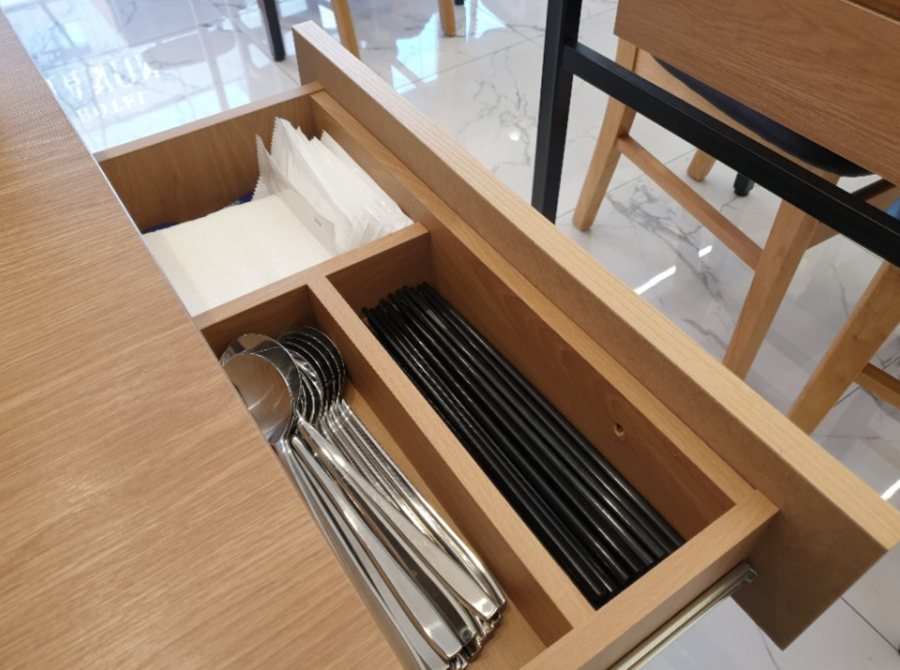
| You can't see any cutlery | It is usually in a drawer on the side of the table, or in a cutlery holder on the table |
The photo below shows a drawer on the side of a table, opened. Spoons, chopsticks, and napkins sit in separate compartments.
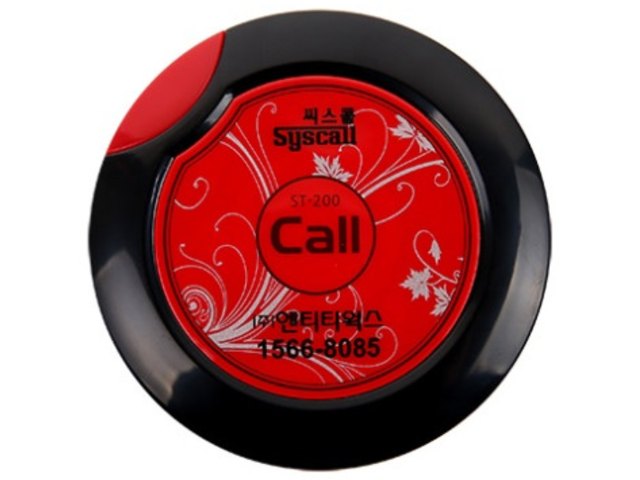
Press the call bell (호출벨, hochulbel) on the table. It is usually at the edge or corner of the table, and at some restaurants it is attached to the outside of the drawer on the side of the table.
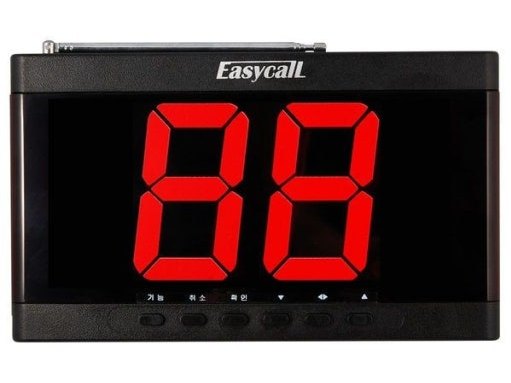
When you press it, your table number appears with a sound on a display where staff can easily see it. Staff see the number and come over quickly. If there is no bell, call out "여기요" (yeogiyo), meaning "Excuse me", or raise your hand and make eye contact.
Ordering works differently from place to place. There are three main ways.
| Method | How |
|---|---|
| With staff | Sit down, look at the menu, say "이거 주세요" (igeo juseyo), meaning "This one, please", and point at the dish |
| Kiosk | Choose and pay at the screen near the entrance. Sit down after paying |
| Table order | Order on the tablet on your table. Whether you pay now or later depends on the restaurant |
At some restaurants, your order is only complete once you have paid on the table-order device. If a card reader sits next to the tablet, it is usually a pay-first system.
If a screen or menu is in Korean only, read it with the camera translation in the Papago app.
At restaurants where you order from staff, pay at the counter near the entrance when you finish. Staff will not come to your table to take payment, even if you wait. Go to the counter and say "계산해 주세요" (gyesanhae juseyo), meaning "I'd like to pay, please".
Some high-end restaurants may bring the bill to your table and return your card there, but ordinary restaurants rarely do this.
Restaurants with kiosks or table-order devices often make you pay up front when you order (선결제, seon-gyeolje). The order screen will show whether it is pay-first.
If your overseas card has ever been declined and left you stuck, read Why Won’t My Card Work in Korea? — A Practical Guide too.
No. Korea has no tipping culture, so you don't need to tip. The price on the menu is what you pay.
Occasionally, if you leave money on the table without saying anything, a staff member will run after you to give it back, saying "you left your money".
Many restaurants have a break time (브레이크타임, beureikeu taim) between lunch and dinner when they close. Some also have a last order (라스트오더, raseuteu odeo) that is earlier than closing time.
Check opening hours and days off in the restaurant's details in the Naver Map app.
Some popular restaurants have a line before they open. For waiting in line and reservations, see Restaurant Reservations & Waitlists in Busan Without a Korean Phone Number (Catchtable Global Guide).
It depends on the restaurant. At some, staff cook it for you from start to finish, some cook only at the start, and at others you cook it yourself. When you sit down, ask "고기 구워 주시나요?" (gogi guwo jusinayo?), meaning "Do you grill the meat for us?"
Tongs and scissors are usually not on the table beforehand. Staff bring them along with the meat. Also remember that many places require at least two servings of grilled meat (see section 3) if you are alone.
In Korea, cutting food with scissors is normal. People from Western countries are often startled the first time, but these are scissors used only for food, so hygiene is not a concern. They are much faster and easier than a knife, which suits a culture that likes things quick and efficient.
Whether you can take leftovers home depends on the restaurant. Many places will not pack soupy dishes. Ask before you eat: "포장돼요?" (pojangdwaeyo?), meaning "Can I get this to go?" If they say no, just leave the food and go.
In Korea, allergen labeling on menus is mandatory only for some restaurants, such as chains with 100 or more outlets that sell children's snack foods. Many neighborhood restaurants have no labels. So you need to tell staff directly when you order.
Menus often show the spice level with red chili pepper icons next to the photo of the dish. Usually it is one to three peppers. Three peppers can be very hot if you are not used to spicy food.
| What you want to say | Korean phrase (pronunciation) |
|---|---|
| I have a peanut (땅콩) allergy | 땅콩 알레르기가 있어요 (ttangkong allereugiga isseoyo) |
| Please leave out the shrimp (새우) | 새우 빼 주세요 (saeu ppae juseyo) |
| Please make it a little less spicy | 덜 맵게 해 주세요 (deol maepge hae juseyo) |
| Please make it not spicy at all | 안 맵게 해 주세요 (an maepge hae juseyo) |
| I am a vegetarian | 저는 채식주의자예요 (jeoneun chaesikjuuijayeyo) |
| What dishes have no meat (고기)? | 고기 없는 메뉴가 뭐예요? (gogi eomneun menyuga mwoyeyo?) |
| I don't eat fish (물고기) either | 이거 물고기 들어가요? (igeo mulgogi deureogayo?), meaning "Does this have fish (물고기)?" |
Korea's allergen list also includes buckwheat, pork, beef, and chicken, which differs from lists in other countries, so check it. If you are vegetarian, the broth in soups is often made from meat or anchovies, so ask "육수도 고기로 만들어요?" (yuksudo gogiro mandeureoyo?), meaning "Is the broth also made with meat?"
Vegan restaurants are not very common in Korea. A search for "비건" (vegan) in the Naver Map app returns few places, and many of them are dessert cafés. So choosing vegetable-based dishes at an ordinary restaurant can be faster. The dishes below usually do not contain meat.
| Dish | What to check when ordering |
|---|---|
| Sanchae bibimbap (산채비빔밥), yachae bibimbap (야채비빔밥) | Rice mixed with seasoned wild greens and vegetables. Ask them to leave off the meat and egg |
| Dotorimuk (도토리묵), mukmuchim (묵무침) | Acorn jelly with vegetables. The ingredients in the seasoning vary by restaurant |
| Dubu jorim (두부조림) | Tofu braised in a seasoning sauce, served as a side dish |
| Kongguksu (콩국수) | Noodles in a cold soy milk broth. Mostly sold in summer |
| Gamjajeon (감자전), yachaejeon (야채전) | Pan-fried vegetable pancakes. Avoid seafood ones such as haemul pajeon (해물파전) |
| Yachae gimbap (야채김밥) | Ham, fish cake, and egg may be inside, so ask them to leave them out |
Many stews, soups, and noodle dishes use meat or anchovy broth. Some banchan, such as myeolchi bokkeum (멸치볶음, stir-fried anchovies), eomuk (어묵, fish cake), and gyeran mari (계란말이, rolled omelet), are hard to identify by sight, so ask "이거 고기 들어가요?" (igeo gogi deureogayo?), meaning "Does this have meat (고기)?" Note that in Korea, "고기" (gogi) often makes people think only of beef or pork, not fish. If you don't eat fish either, ask separately: "이거 물고기 들어가요?" (igeo mulgogi deureogayo?), meaning "Does this have fish?"
| Topic | One thing to remember |
|---|---|
| Eating alone | Search "혼밥" in the Naver Map app |
| Water and banchan | If it says "셀프", help yourself |
| Calling staff | Press the call bell on the table |
| Paying | At the counter on your way out, or up front when you order |
| Tipping | Not needed |
| Allergies | Tell staff directly |
For everyday life in Korea more broadly, also read Why Do Koreans Ask Your Age First? 12 Everyday Korea Questions Foreigners Ask Most.